The American Indians of USA.
Obviously, they are all a bunch of ranting, raving, seething, vicious, genocidal, hate-filled scum, right? No, wait. They can't be. Only White people can be racist. I forgot. Silly me.
So where are the Nutcase Liberal-Left and the Minority Professional Victims when it comes to abusing these vicious, evil US Amerindians? Nowhere to be seen. Why is that? They're all busy beating up on those vile White folks.
Why are US Amerindians so anti-immigration? Think about it. Real hard.
Showing posts with label Amerindians. Show all posts
Showing posts with label Amerindians. Show all posts
Saturday, November 29, 2008


Thursday, November 27, 2008
Crime Rates For Hispanics, Polynesians and Amerindians
In the comments section, an anonymous commenter notes:
I have already discussed this in some of my other posts. It is true that elevated rates of crime among Asian-derived groups are somewhat mysterious.
However, no one knows what the testosterone levels of any of these groups are, nor do we have much information about personality styles, although Richard Lynn claims that numerous studies show that Amerindians have elevated rates of sociopathy.
However, they all have relatively low IQ's (Hispanics = 92*, Amerindians = 90*, Polynesians = 89*) and in modern industrial capitalism, lower-IQ groups resort to mass crime, probably due to failure to achieve the successes that society tells them they deserve and the resulting extreme frustration.
This failure is probably to a great degree due to lowered IQ levels. Lower IQ groups generally do not do well in modern urban societies.
Hispanics have high crime rates in all of the capitalist nations of the Americas. The more Amerindian blood, the higher the crime. Pure Amerindians also seem to commit a lot of crime in Latin American urban areas. These people evolved in tribal societies and lately in small villages. Modern urban capitalism is just something they can't cope with. They didn't evolve with it, culturally or otherwise.
I doubt of Amerindians are persecuted much at all in most of the US (although there is a lot of anti-Indian racism in North Dakota at least). In this part of the country, AMERICAN (not Mesoamerican) Indians are highly regarded, and many Whites around here want to be Indians (Indian wannabes).
There are lots of California Indians living in these foothills here, and racism against them seems to be about zero, although there would seem to be grounds for some because their levels of pathology are unbelievably high and some of them live in nearly unimaginable filth and squalor, apparently deliberately. Most of their problems is this part of the country are self-inflicted.
Some tribes around here became very wealthy with casino money.
One tribe was giving out $7000/month checks to members, but they didn't seem to act much better. Most of the young ones blew every nickel of the money on dope, alcohol, gambling and whatnot, did not invest in or improve housing stock (you drive by there and see 20-30 Indians of all ages lounging about with chickens running everywhere in a trashed-out front yard).
However, a few of them did save and invest the money. I know one fellow who is a millionaire who invests in many business ventures.
In this part of California, there is no discrimination against Hispanics at all. My city is majority Hispanic. They run the whole place. The only racism in that town is against White people. Hispanics are in charge in large swathes of this state. From my POV, they experience little or no discrimination or racism as a dominant group.
There is little to no discrimination or racism against Samoans or Tongans here either.
I can't speak of Hawaii.
I really don't think that any of these groups qualify as persecuted minorities, at least not in California. Other than lower IQ's, I don't have a good explanation for elevated crime rates though.
American Samoa has very high crime, while Western Samoa next door, with a traditional Polynesian lifestyle, is nearly crime-free. Clearly, Polynesian crime is predicated to a large degree on culture.
I understand that Mexico, especially in smaller villages, did not use to have a lot of crime. This has certainly changed recently.
It is extremely difficult to generalize about Amerindian behaviors. The Amerindian behavioral phenotype, like the Polynesian one, seems to be quite plastic and is capable of expressing itself in many different ways depending on the environment.
It's well-known that there are Amerindian tribes, especially in the Amazon, who are so pacifistic that it's almost comical. I can think of at least one in Venezuela. Curiously, they live near the Yanonamo, long thought to have the highest homicide rate on Earth. I doubt if their genes are much different.
With a relatively plastic behavioral phenotype, Amerindians are possibly highly susceptible to culture. In a pro-violence culture they can become ridiculously violent and criminal. In a culture that promotes pacifism and non-violence, they can become so peaceful that that it is almost a caricature. These are tribal people who evolved culturally to strictly abide by tribal cultural norms.
I suspect Polynesians also may have a plastic behavioral phenotype. The differences in the two Samoas suggest that Polynesian criminal behavior is heavily mediated by culture.
This is discussed in greater depth in the previous post, The Moriori and the Dangers of Pacifism.
Crime is about a Hell of a lot more than testosterone.
Criminology is traditionally a black hole for theory.
*Three points were added to each score due to the recent renorming of US IQ scores.
Hispanics, Amerindians, and Polynesians are all Asians or have Asiatic roots (and thus presumably lower testosterone) and still their crime rate is higher than Whites...this suggests that there is a social element to crime rates as well, probably related to the status of these groups as 'persecuted minorities.'I respond:
I have already discussed this in some of my other posts. It is true that elevated rates of crime among Asian-derived groups are somewhat mysterious.
However, no one knows what the testosterone levels of any of these groups are, nor do we have much information about personality styles, although Richard Lynn claims that numerous studies show that Amerindians have elevated rates of sociopathy.
However, they all have relatively low IQ's (Hispanics = 92*, Amerindians = 90*, Polynesians = 89*) and in modern industrial capitalism, lower-IQ groups resort to mass crime, probably due to failure to achieve the successes that society tells them they deserve and the resulting extreme frustration.
This failure is probably to a great degree due to lowered IQ levels. Lower IQ groups generally do not do well in modern urban societies.
Hispanics have high crime rates in all of the capitalist nations of the Americas. The more Amerindian blood, the higher the crime. Pure Amerindians also seem to commit a lot of crime in Latin American urban areas. These people evolved in tribal societies and lately in small villages. Modern urban capitalism is just something they can't cope with. They didn't evolve with it, culturally or otherwise.
I doubt of Amerindians are persecuted much at all in most of the US (although there is a lot of anti-Indian racism in North Dakota at least). In this part of the country, AMERICAN (not Mesoamerican) Indians are highly regarded, and many Whites around here want to be Indians (Indian wannabes).
There are lots of California Indians living in these foothills here, and racism against them seems to be about zero, although there would seem to be grounds for some because their levels of pathology are unbelievably high and some of them live in nearly unimaginable filth and squalor, apparently deliberately. Most of their problems is this part of the country are self-inflicted.
Some tribes around here became very wealthy with casino money.
One tribe was giving out $7000/month checks to members, but they didn't seem to act much better. Most of the young ones blew every nickel of the money on dope, alcohol, gambling and whatnot, did not invest in or improve housing stock (you drive by there and see 20-30 Indians of all ages lounging about with chickens running everywhere in a trashed-out front yard).
However, a few of them did save and invest the money. I know one fellow who is a millionaire who invests in many business ventures.
In this part of California, there is no discrimination against Hispanics at all. My city is majority Hispanic. They run the whole place. The only racism in that town is against White people. Hispanics are in charge in large swathes of this state. From my POV, they experience little or no discrimination or racism as a dominant group.
There is little to no discrimination or racism against Samoans or Tongans here either.
I can't speak of Hawaii.
I really don't think that any of these groups qualify as persecuted minorities, at least not in California. Other than lower IQ's, I don't have a good explanation for elevated crime rates though.
American Samoa has very high crime, while Western Samoa next door, with a traditional Polynesian lifestyle, is nearly crime-free. Clearly, Polynesian crime is predicated to a large degree on culture.
I understand that Mexico, especially in smaller villages, did not use to have a lot of crime. This has certainly changed recently.
It is extremely difficult to generalize about Amerindian behaviors. The Amerindian behavioral phenotype, like the Polynesian one, seems to be quite plastic and is capable of expressing itself in many different ways depending on the environment.
It's well-known that there are Amerindian tribes, especially in the Amazon, who are so pacifistic that it's almost comical. I can think of at least one in Venezuela. Curiously, they live near the Yanonamo, long thought to have the highest homicide rate on Earth. I doubt if their genes are much different.
With a relatively plastic behavioral phenotype, Amerindians are possibly highly susceptible to culture. In a pro-violence culture they can become ridiculously violent and criminal. In a culture that promotes pacifism and non-violence, they can become so peaceful that that it is almost a caricature. These are tribal people who evolved culturally to strictly abide by tribal cultural norms.
I suspect Polynesians also may have a plastic behavioral phenotype. The differences in the two Samoas suggest that Polynesian criminal behavior is heavily mediated by culture.
This is discussed in greater depth in the previous post, The Moriori and the Dangers of Pacifism.
Crime is about a Hell of a lot more than testosterone.
Criminology is traditionally a black hole for theory.
*Three points were added to each score due to the recent renorming of US IQ scores.
Tuesday, November 25, 2008
More Race in Latin America
Following on the heels of a couple of posts on the racial composition of Hispanics and Latin America in general, let us look a little further into the issue.
First of all, let us look at the racial breakdown of Puerto Ricans. Genetic studies of Puerto Ricans have shown that they are on average 53.3% White (Spaniard), 29.1% Black, and 17.6% Amerindian, or, to put it another way, those numbers reflect their total genetic base.
So you can see that Puerto Ricans are very much mixed-race people, but on the other hand, they are mostly White, or at least much more White than Black or Amerindian. The predominance of White over Amerindian and/or Black genes is common in Latin America.
Rather than being a continent primarily of Amerindians or Blacks, the story of Latin America is one of mestizaje, the marriage of two great races - the White European and the Amerindian. In many cases, especially around the Caribbean, there are varying degrees of Black too, but they do not tend to predominate.
This sort of Black - Amerindian - White mixed race phenomenon is actually pretty common in and around the Caribbean. This is the predominant phenotype in Venezuela (Hugo Chavez is a good example), Panama and Brazil, and is also common in Cuba and Colombia. It is also common along the Caribbean coasts of Mexico, British Honduras, Honduras, Costa Rica and Nicaragua.
Studies of race in Brazil has produced some interesting results.
For one thing, the concept of "White" in Brazil, and probably in Latin America in general, is not the same as in the US. Latin America is a mixed-race continent. White often means simply lighter-skinned than other folks. The concept of social race is also common, whereby a Black man with money becomes White simply by acquiring cash, education and upper class status.
In Brazil, a majority of the population refers to themselves as White, but as I said, that does not mean the same thing as in the US. Towards the southern end of Brazil, you do have some American-style relatively pure Whites.
A study of self-identified Whites in Rio Grande do Sul did find one group that was almost 100% Caucasian - they were mostly descendants of Italian immigrants. But another group of self-identified Whites had 18% Indian and 8% Black genes, all on the mother's side. Therefore, they were 87% White, 9% Amerindian and 4% Black.
It is common in Latin America for non-White genes to be on the mother's side, reflecting the common practice of European males taking Black or Indian spouses.
Whites in Brazil are not necessarily White in an American sense.
I spent a lot of time at One Drop Rule going over many studies of race in Latin America.
The results are variable and confusing, but one thing became clear. Race is not as clear-cut a category in Latin America as in the US. Latin American Whites typically had more Amerindian or Black blood than US Whites. Even Amerindians were rarely pure, at least in Mexico. However, Amerindians from Oaxaca, Chiapas, Guatemala and the Andes of Peru, Ecuador and Bolivia are probably pure Indian or close to it.
In one study, a Mexican Indian tribe was significantly mixed in with White at ~20% or so. Keep in mind that someone who is 80% Indian will look very Indian. We have a local Indian tribe where I live, and there is one full-blood left out of 800 Indians. Yet many of those who are a little mixed look very Indian.
With a mulatto President, mass immigration from Latin America, and increasing racial intermarriage, the story of the continent - mestizaje, and to a lesser extent, mulattoization, figures to be increasingly America's story too in coming decades. As always, it promises to be interesting.
First of all, let us look at the racial breakdown of Puerto Ricans. Genetic studies of Puerto Ricans have shown that they are on average 53.3% White (Spaniard), 29.1% Black, and 17.6% Amerindian, or, to put it another way, those numbers reflect their total genetic base.
So you can see that Puerto Ricans are very much mixed-race people, but on the other hand, they are mostly White, or at least much more White than Black or Amerindian. The predominance of White over Amerindian and/or Black genes is common in Latin America.
Rather than being a continent primarily of Amerindians or Blacks, the story of Latin America is one of mestizaje, the marriage of two great races - the White European and the Amerindian. In many cases, especially around the Caribbean, there are varying degrees of Black too, but they do not tend to predominate.
This sort of Black - Amerindian - White mixed race phenomenon is actually pretty common in and around the Caribbean. This is the predominant phenotype in Venezuela (Hugo Chavez is a good example), Panama and Brazil, and is also common in Cuba and Colombia. It is also common along the Caribbean coasts of Mexico, British Honduras, Honduras, Costa Rica and Nicaragua.
Studies of race in Brazil has produced some interesting results.
For one thing, the concept of "White" in Brazil, and probably in Latin America in general, is not the same as in the US. Latin America is a mixed-race continent. White often means simply lighter-skinned than other folks. The concept of social race is also common, whereby a Black man with money becomes White simply by acquiring cash, education and upper class status.
In Brazil, a majority of the population refers to themselves as White, but as I said, that does not mean the same thing as in the US. Towards the southern end of Brazil, you do have some American-style relatively pure Whites.
A study of self-identified Whites in Rio Grande do Sul did find one group that was almost 100% Caucasian - they were mostly descendants of Italian immigrants. But another group of self-identified Whites had 18% Indian and 8% Black genes, all on the mother's side. Therefore, they were 87% White, 9% Amerindian and 4% Black.
It is common in Latin America for non-White genes to be on the mother's side, reflecting the common practice of European males taking Black or Indian spouses.
Whites in Brazil are not necessarily White in an American sense.
I spent a lot of time at One Drop Rule going over many studies of race in Latin America.
The results are variable and confusing, but one thing became clear. Race is not as clear-cut a category in Latin America as in the US. Latin American Whites typically had more Amerindian or Black blood than US Whites. Even Amerindians were rarely pure, at least in Mexico. However, Amerindians from Oaxaca, Chiapas, Guatemala and the Andes of Peru, Ecuador and Bolivia are probably pure Indian or close to it.
In one study, a Mexican Indian tribe was significantly mixed in with White at ~20% or so. Keep in mind that someone who is 80% Indian will look very Indian. We have a local Indian tribe where I live, and there is one full-blood left out of 800 Indians. Yet many of those who are a little mixed look very Indian.
With a mulatto President, mass immigration from Latin America, and increasing racial intermarriage, the story of the continent - mestizaje, and to a lesser extent, mulattoization, figures to be increasingly America's story too in coming decades. As always, it promises to be interesting.
References
- Marrero, AR, Das Neves Leite, FOP, De Almeida Carvalho, B, Peres, LM, Kommers, TC, Da Cruz, IM, Salzano, FM, Ruiz-Linares, A, Da Silva Júnior, WA, Bortolini, MC. 2005. Heterogeneity of the Genome Ancestry of Individuals Classified As White in the State Of Rio Grande Do Sul, Brazil. Am J Hum Biol. Jul-Aug 17(4):496-506.
Sunday, November 16, 2008
Does Welfare Cause Crime?
In the comments, Uncle Milton says:
The more capitalism, the more crime. This is proven in the transition from socialism to capitalism in the FSU, Eastern Europe and China which were followed by tremendous crime waves.
If you cut all those folks in the ghetto off of all the welfare, would they be any less criminal?
There doesn't seem to be any theoretical model for why welfare would cause crime. Why would giving someone stuff turn him into a criminal? According to Uncle Milton, it is because they "feel they are owed something."
But aren't people owed something under Communism? Basic needs were provided for everyone. Perhaps Communism was the ultimate welfare state. At least this is what conservatives say. How then did Communist states have the lowest levels of crime around?
Furthermore, I would point out that the 3rd World equivalent of our ghettos are often vastly more dangerous that US ghettos. I worked in the ghettos and barrios of Los Angeles for years and I lost one car battery in a East LA and I had the wires cut on another car battery in Watts. Of course, I was usually out of there before dark.
I lived in Oakhurst, a town in the Sierra Nevada, for 16 years. I don't know the figures, but word is that the welfare use rate was very high the whole time I was there. Girls got pregnant as soon as they got out of high school (18-20 or so) and the guy may or may not be around.
Many just became single Moms for various periods of time. I suppose there were guys floating in and out of their lives, but that's how it goes with single Moms in general. In my apartment complex, there were two single Moms out of six tenants.
The guys support the kids in some cases and marry them in others, but in quite a few cases, they don't marry the woman, and in other cases, they do not support them either.
Although the rate of this sort of thing among the Amerindians in town is insanely high, I would like to focus on the Whites. There is a very high rate of welfare use among Whites in this town. This includes all kinds of welfare - food stamps, Medicaid, welfare proper, etc. There was very little crime in this town.
The crime rate was so low that I often did not lock my car at home and often left the house without locking the door. I did that for years with no break-ins. Violent crime was nearly nonexistent. Gangs did not exist, and juvenile crime did not seem to be significant from my POV.
I had heard that it took a long time for a welfare culture to develop as kids come of age and become pathological due to being raised in a welfare family. I watched this scene for 16 years and no welfare culture developed. I assume that was enough time.
It's an interesting question why high welfare use seems to be associated with mass pathology in some groups (Hispanics and Blacks) but not in others (Asians and Whites). Even in Oakhurst, relatively high levels of pathology coincided with extremely high welfare use among Amerindians. Nevertheless, with Amerindians about 5% of the population, they were not a significant crime problem.
So much for welfare causes crime.
I have spent extensive time in third world countries. In general I found them much safer than the inner cities of the US which are filled with people who collect checks from the government and still feel strongly they are owned something and will take it out on each and anyone wandering into their midst.The notion that "welfare causes crime" is very problematic. I don't believe that the folks pushing this argument have ever proved their case. In Europe, there is a good model backed up with many studies that shows that the more socialism you have in the system, the less crime you have.
The more capitalism, the more crime. This is proven in the transition from socialism to capitalism in the FSU, Eastern Europe and China which were followed by tremendous crime waves.
If you cut all those folks in the ghetto off of all the welfare, would they be any less criminal?
There doesn't seem to be any theoretical model for why welfare would cause crime. Why would giving someone stuff turn him into a criminal? According to Uncle Milton, it is because they "feel they are owed something."
But aren't people owed something under Communism? Basic needs were provided for everyone. Perhaps Communism was the ultimate welfare state. At least this is what conservatives say. How then did Communist states have the lowest levels of crime around?
Furthermore, I would point out that the 3rd World equivalent of our ghettos are often vastly more dangerous that US ghettos. I worked in the ghettos and barrios of Los Angeles for years and I lost one car battery in a East LA and I had the wires cut on another car battery in Watts. Of course, I was usually out of there before dark.
I lived in Oakhurst, a town in the Sierra Nevada, for 16 years. I don't know the figures, but word is that the welfare use rate was very high the whole time I was there. Girls got pregnant as soon as they got out of high school (18-20 or so) and the guy may or may not be around.
Many just became single Moms for various periods of time. I suppose there were guys floating in and out of their lives, but that's how it goes with single Moms in general. In my apartment complex, there were two single Moms out of six tenants.
The guys support the kids in some cases and marry them in others, but in quite a few cases, they don't marry the woman, and in other cases, they do not support them either.
Although the rate of this sort of thing among the Amerindians in town is insanely high, I would like to focus on the Whites. There is a very high rate of welfare use among Whites in this town. This includes all kinds of welfare - food stamps, Medicaid, welfare proper, etc. There was very little crime in this town.
The crime rate was so low that I often did not lock my car at home and often left the house without locking the door. I did that for years with no break-ins. Violent crime was nearly nonexistent. Gangs did not exist, and juvenile crime did not seem to be significant from my POV.
I had heard that it took a long time for a welfare culture to develop as kids come of age and become pathological due to being raised in a welfare family. I watched this scene for 16 years and no welfare culture developed. I assume that was enough time.
It's an interesting question why high welfare use seems to be associated with mass pathology in some groups (Hispanics and Blacks) but not in others (Asians and Whites). Even in Oakhurst, relatively high levels of pathology coincided with extremely high welfare use among Amerindians. Nevertheless, with Amerindians about 5% of the population, they were not a significant crime problem.
So much for welfare causes crime.
Wednesday, November 05, 2008
Amerindians, Hypertension and Obesity
The latest death toll figures from Hurricane Katrina can be seen on this website here. The famous Russian neo-Nazi video is on this blog here.
Updated November 19:
I recall when I worked for an Indian tribe a decade or so ago. Some silly White liberal health workers came in one day and I went in to talk to them. What was I doing at the Indian tribal headquarters? Why, I was employed on a government grant as an anthropologist and linguist. Wow, how fascinating! And what did these silly PC health workers do? Why, they went around wherever doing health work with Indians.
Why did so many of these Indians have high blood pressure? I was dying to know. First came denial. Whites have HTN too, you know. The angry, suspicious and uncomfortable looks were already starting. Ok, but Indians have more. Way more. What’s it all about? The entire conversation was soon veiled in hostility, suspicion and out and out bad vibes.
I finally got out of these idiots that the diabetes epidemic among these Indians was giving them HTN. Diabetes causes hypertension. How? It destroys your blood vessels by narrowing them. Narrow blood vessels gives you HTN. Why the diabetes? Abandoning the native diet and the taking up (with gusto) of absolutely the very worst (And I do mean the worst!) aspects of the White man’s diet.
I suggested that the high Indian rate of diabetes was due to genetics and an inability to adapt to a White diet they had not evolved to eat. By this time my conversation with the idiotic White health workers had deteriorated, and I kept trying to rescue it. Did you know that genetics and genes do not exist, or, if they do, that they are irrelevant in humans? That there is no such thing as race?
I had wandered into race-denier Hell and, as in a Sartre play, there was "No Exit." Accusations of racism, veiled and otherwise, were hurled in my direction. I was an evil racist and I deserved to die.
Turns out Indians, like indigenous peoples all over, have adopted a thrifty metabolism due to surviving many famines. You have a horrible famine, and the only folks that survive are the ones who can eat hardly any food and somehow manage to not die. Their genes get passed on, and you end up with a race that doesn't need much food to get by.
They live well on a native diet, but on a modern diet (which they invariably adopt the very worst aspects of) they become obese and develop epidemic diabetes and all of the resulting problems. This is also true among Oceanians, Aborigines and Hispanics, who have lots of Indian blood.
The Indians’ idiotic response to this was to blame Whitey for creating an evil diet and I guess force-feeding it to poor helpless Indians, probably by feeding tubes while they were strapped helplessly to their hospital beds. My response, muttered under my breath many times, was, "So quit eating it already!"
Actually I said it out loud a few times. Yep, they admitted doggedly, we gotta quit eating this crappy White man's food. Next time you see them at the supermarket, it's a whole shopping basket loaded up with the very worst foods in the store, and the Indian pushing it can barely squeeze through the aisle.
Some people never learn.
Indians are addicted to the Blame Whitey Game. It’s their favorite pastime.
Note: Readers should carefully read the Commenting Rules before commenting to avoid having their comments edited or deleted and to avoid being banned from the site.
Updated November 19:
I recall when I worked for an Indian tribe a decade or so ago. Some silly White liberal health workers came in one day and I went in to talk to them. What was I doing at the Indian tribal headquarters? Why, I was employed on a government grant as an anthropologist and linguist. Wow, how fascinating! And what did these silly PC health workers do? Why, they went around wherever doing health work with Indians.
Why did so many of these Indians have high blood pressure? I was dying to know. First came denial. Whites have HTN too, you know. The angry, suspicious and uncomfortable looks were already starting. Ok, but Indians have more. Way more. What’s it all about? The entire conversation was soon veiled in hostility, suspicion and out and out bad vibes.
I finally got out of these idiots that the diabetes epidemic among these Indians was giving them HTN. Diabetes causes hypertension. How? It destroys your blood vessels by narrowing them. Narrow blood vessels gives you HTN. Why the diabetes? Abandoning the native diet and the taking up (with gusto) of absolutely the very worst (And I do mean the worst!) aspects of the White man’s diet.
I suggested that the high Indian rate of diabetes was due to genetics and an inability to adapt to a White diet they had not evolved to eat. By this time my conversation with the idiotic White health workers had deteriorated, and I kept trying to rescue it. Did you know that genetics and genes do not exist, or, if they do, that they are irrelevant in humans? That there is no such thing as race?
I had wandered into race-denier Hell and, as in a Sartre play, there was "No Exit." Accusations of racism, veiled and otherwise, were hurled in my direction. I was an evil racist and I deserved to die.
Turns out Indians, like indigenous peoples all over, have adopted a thrifty metabolism due to surviving many famines. You have a horrible famine, and the only folks that survive are the ones who can eat hardly any food and somehow manage to not die. Their genes get passed on, and you end up with a race that doesn't need much food to get by.
They live well on a native diet, but on a modern diet (which they invariably adopt the very worst aspects of) they become obese and develop epidemic diabetes and all of the resulting problems. This is also true among Oceanians, Aborigines and Hispanics, who have lots of Indian blood.
The Indians’ idiotic response to this was to blame Whitey for creating an evil diet and I guess force-feeding it to poor helpless Indians, probably by feeding tubes while they were strapped helplessly to their hospital beds. My response, muttered under my breath many times, was, "So quit eating it already!"
Actually I said it out loud a few times. Yep, they admitted doggedly, we gotta quit eating this crappy White man's food. Next time you see them at the supermarket, it's a whole shopping basket loaded up with the very worst foods in the store, and the Indian pushing it can barely squeeze through the aisle.
Some people never learn.
Indians are addicted to the Blame Whitey Game. It’s their favorite pastime.
Note: Readers should carefully read the Commenting Rules before commenting to avoid having their comments edited or deleted and to avoid being banned from the site.
Saturday, October 18, 2008
The Origin of the Amerindians
The latest death toll figures from Hurricane Katrina can be seen on this website here. The famous Russian neo-Nazi video is on this blog here.
Updated November 27. I am republishing this post because I added a lot of new photos and text. Enjoy.
As we noted in an earlier post, the view is converging that Amerindians can be traced back to the Altai Mountains in Southwest Siberia where China, Mongolia and Russia all come together.
Yet another study found that of all Asians, the Turkic-speaking tribes of the Sayan Mountains (west of the Altai Mountains and north of northwestern Mongolia) are the closest to the Amerindians. This group includes the Shor, the Tofalar, the Altai, the Khakass , the Soyots and the Tuva. The Mongolic-speaking Buryats are also included.
The Altai live in the Sayan Uplands. The Soyots and the Buryats are from the Eastern Sayan Mountains. The Shor and the Khakass are from the northwest slopes of the Sayans. The Tofalar are from the northern slopes of the Eastern Sayans. The Tuva are also from the Sayans.
 This is an ensemble of Khakass singers called the Sume-r Ensemble. They sure look like Amerindians, don't they. The Khakass, Turkic speakers of the Sayan Mountains, are related to Amerindians. The Khakass language is in good shape, with 60,000 speakers. The Khakass belong to the Central Asian Mongoloid group. They have wide faces and cheekbones are not very prominent. They are short, with dark skin, and are able to grow beards.
 This is a traditional shaman woman of the Altai-Kizhi group of the Altai. Of all of the groups listed above, the Altai are one of the closest of all to the Amerindians. As you can see, this woman looks very Amerindian, all the way down to the face paint. She's even beating on a drum. I can't believe that there is something like a tepee in the background.
Another powerful connection is that all of these groups practiced Shamanism very prominently. And we know what the aboriginal religions of the Amerindians were - forget all that "Great Creator" crap - most of that was lobbed on recently after they became Christians. The aboriginal religions of the Amerindians were animism and shamanism, combined.
 Bama Kanda, a famous Buryat. I believe she is a singer. Although the Buryat look a lot more like typical Asians (note the resemblance to a Mongolian or a Korean here) several studies have now related them to the Amerindians. Strangely enough, the Buryats have an oral tradition that says that a group of them went to the Americas long ago.
 From a book called The Last of the Shor Shamans. He looks quite Amerindian. It showcases a few remaining Shor elders who still practice Shamanism and looks into their worldview. The Shor language is doing ok, but it is on the decline all right. Quite a few kids are still speaking it.
The Shor are Uralics, but they have Mongoloid features. They are short, with broad, flat faces. They have light skin and light eyes and can grow a thick beard. The Shors have not done well, and alcoholism and VD are devastating them.
 Galina Innokentievna Adamova, a member of the Fast Reindeer folksinging group. She looks like an Amerindian, and her costume even looks Amerindian. The Tofalar language is not doing well. It's not being spoken by kids. About 30% of the Tofalar speak the language, almost all elderly.
It's being taught for 1 hour a week in some elementary schools, and the teacher is not even fluent in Tofalar. She conducts the class in Russian. Other villages do not even have schools, and the kids are shipped away to boarding schools.
We have to conclude that once a language is no longer spoken in the home and is reduced to a subject in school, it's probably on its way out.
The Tofalar are also members of the Mongoloid Central Asian race. They are short, with high, flat faces, without prominent cheekbones.
 Nikolay Sergeevich Bakanaev, an expert in Tofalar fairy tales. I can't believe how much this guy looks like an Amerindian.
The Ket and Selkup are also related to Amerindians, though they are now to the north of the Altai. However, a long time ago, the Ket and Selkup lived in the Altai, and they only moved north later on.
 Katun River in the Altai Mountains, origin of the vast majority of the Amerindians. The ancestors of the Amerinds probably left this region to come to the Americas about 16-30,000 years ago.
Another paper has found that there were two waves to the Americas - the first wave, mentioned above, traced back to the Tuva of the Altai, occurred 20-30,000 years ago, not 16,000 years ago as suggested in the paper above. This group moved first to the Chukotka Peninsula, and then into the Americas. They constitute the Amerind speakers of North, Central and South America.
 A Tuvan family, ancestors of the vast majority of Amerindians. Tuvans, who live in the Altai Mountains where Russia, China and Mongolia all come together, have one of highest rates of syphilis in the world, attributed to an old shamanistic tradition that encouraged promiscuity among females. The more sex partners a woman had before marriage, the more fertile she would be. It's obviously not scientifically based.
 A Selkup woman. Galina Vladimirovna Kusamina (nee Tamelkina), age 47. Photographed at the Farkovo settlement. The Selkups are not doing well. There is high unemployment, an extremely high rate of alcoholism, and they are victims of racial discrimination. The Selkup are members of the Uralic Race. The origins of the Uralics are pretty obscure. Their language is Samoyedic. Samoyedic is very distantly related to Finnish, Estonian and Hungarian.
Some say that this race is neither Mongoloid nor Caucasoid. Genetically, they do seem to fall in with the Asians. They are short and have short skulls. Asian traits are diminished, and their skin is fairer than in surrounding groups. These people, along with the Ket, are also ancestors of the Amerindians.
This paper also found evidence for a second wave of Siberians to the Americas. This wave came out of the Lower Amur River region near Sakhalin Island, where Russia, China and Korea all together. This wave gave rise to the Na-Dene speakers and the surrounding populations of Amerinds.
 The Lower Amur River region, where the ancestors of the Na-Dene came from. The Amur is said to be one of the world's 10 great rivers.
The Na-Dene migration occurred about 6-7,000 years ago. Some peoples who live in the Lower Amur region include the Negidal, the Ulchi , and Orok and the Udeghe. This paper found that the Negidal and the Ulchi were the progenitors of the Na-Dene.
 Click to enlarge. The Lower Amur region of Russia can be seen to the left of Sakhalin Island. On this map, tribes residing in the Lower Amur region include the Negidal, the Ulchi, the Nivkhi, the Oroch, the Udeghe and the Nanai.
 D. I. Nadeina, a Negidal elder who has been working with linguists in Vladimirovka village, north of Japan near Sakhalin Island. The Negidal language was devastated by the post-Stalin USSR which sent the kids off to boarding schools.
10-30% of the Negidal have a command of the language, but only 10% are speakers, all older adults. Younger adults can understand Negidal but not speak it. Kids speak only Russian. There are only 500 of them left. The language is not written and there is no instruction in it. You can see that she looks Japanese, but anthropologically, thees people are called Paleo-Siberians, members of a group called Baikals. These people are the ancestors of the Na-Dene and surrounding tribes of Amerindians.
 Ulchi children in native dress. They look pretty Japanese to me, but the picture does not have good resolution. The Ulchi are ancestors of the Na-Dene Amerindians.
 Ulchi women being baptized into Christianity. At first glance I thought that they looked Japanese, but now I am going to say Korean. Anthropologically, they are just said to be Mongoloids of no pure type. Part of them belong to a type called Sakhalin-Amur . These types are short, with a broad, flat face and relatively dark skin. The men may have thick beards.
The Ulchi live, like the Negidal, in the Khabarovsk Krai District of Russia along the lower Amur River north of Japan and northeast of Manchuria, west of Sakhalin Island. The capital of the area is Bogorodskove, about 470 miles north of Japan.
30-40% of the Ulchi have command of the language. Older speakers know it well, the middle-aged less well, adolescents and young adults understand it passively. People under age 20 are not able to speak the language. There is a script and it is taught in schools. The language is used in the home. They are known to hunt seals.
Researching classic genetic markers reveals an interesting story. M130 goes out of Africa, to India and SE Asia (these are the Negritos), then up the coast to North America and the Na-Dene. Originally, M130 is obviously Australoid-Negrito but they go to NE Asian at some point (probably about 9,000 years ago).
Theirs must have been a coastal migration. The remains are in Northwest Canada, Oregon and the Northern California coast, but most of them are probably underwater. They must have gone inland at some point to become the Navajo - Apache. This is the same Lower Amur line that went to the Na-Dene in the paper above.
We know that the original lines in the Lower Amur region came from SE Asia. This mirrors the theories about the Ainu Jomon culture originating in Thailand 16,000 years ago. This correlation is based on a comparison of skulls from Thailand 16,000 years ago with the Jomonese who showed up in Japan shortly after and with the present day Ainu. All three seem to line up.
The tribes of the Lower Amur seem to have a similar provenance to the Ainu.
 Ainu men with full beards. As you can see, they do look somewhat Caucasian. However, analysis of their skulls shows that they are Australoid. Their genes are Asian, showing relations to the Andaman Islanders (!) and Tibetans. The Andaman Islanders are the remains of the very first men out of Africa. If the Ainu are related to them, this shows that the Ainu are very ancient indeed.
The tribes of the lower Amur region probably derive from the Ainu. Genetics shows that this line came from SE Asia. A good theory is that the Jomon Culture, which showed up in Japan 16,000 years, is derived from a culture that existed in Thailand at the same time. The archaic Thai left Thailand and came up to Japan, possibly by boats. The skulls of the archaic Thai, the Jomonese and the Ainu all line up.
So the ancestors of the Ainu lived in Thailand 16,000 years ago and earlier and left to come up to Japan to become the Jomonese. It seems that the Ainu were on the move at this time. The Ainu also seem to be connected to the Murrayans, who arrived in Australia, possibly from either Thailand or Japan between 15-20,000 years ago. There is also evidence that they stopped by the Philippines on their way to Australia from wherever.
This is probably the same group as the proto-Australoids, the second group to come to the Philippines. So the Ainu are probably the ancient Thai from 16,000 years ago, the Jomonese from the same time, the Murrayans who arrived in Australia 15-20,000 years ago, the proto-Australoids who came to the Philippines around the same time and the proto-SE Siberians, who probably showed up there around 16,000 years ago.
The earliest Amerindians from 9,000-12,5000 years ago also look like Ainu. It seems that from 9,000-16,000 years ago in Asia, the proto-Ainu were really on the move.
Traditional, older anthropology has held that when the Ainu came to Japan, possibly 16,000 years ago, Japan was already inhabited. It is thought that Japan was inhabited by Negrito types prior to 16,000 years ago.
The Ainu replaced these Japanese Negritos, probably by killing them off. These people were called by the Ainu the pit-dwellers or koro-pok-guru (men with sunken places). These koro-pok-guru were said to be so small as to be considered dwarfs. The only logical interpretation is that these people were Negritos.
 An Ainu man with full beard. The Ainu came to Japan from the Kuril Islands to the north, possibly 16,000 years ago. They were hunter-gatherers and liked to eat meat. They were deerskin leggings and salmon skin boots. Their religion was animism. They were said to be very dirty people who seldom washed for some reason. A man who lived with them 100 years ago for six weeks said they never bathed in that time and never washed any utensils.
They worshiped the bear. Every year they had a Bear Festival and their highest compliment was to compare a man to a bear. The Ainu are pretty unique in this regard, as worship of bears is not common. On the other hand, the Ainu hunted bears, wore their skins and ate their meet. They were said to be a peaceful, kind people and did not practice capital punishment - although someone guilty of murder was mutilated, they were allowed to live.
Along the same lines, another paper found that Amerindians trace back to Mongolia, Manchuria and far southeastern Siberia (the Lower Amur River). The Altai and Buryat populations (just north of Mongolia) were included in the founders. This paper said that Amerindians came 22-29,000 years ago. There are very early sites in Beringia dating back 30,000 years, but they are controversial.
 Beringia is now inhabited by Eskimos or Inuit. They are quite close genetically to Asians and they are not really Amerindians. They came quite late. Notice the resemblance to, say, Japanese.
This study found a single 30,000 year old gene in Amerindians. Based on this gene and an earlier study of classic genetic markers that suggested a time of entry at 32,000 years, this study postulated that Amerindians arrived in the Americas 30,000 years ago.
This study (broken link) found a single wave of entry 23-27,000 years ago populating the Americas.
It is now commonly agreed that the first Amerindians were Australoids. These are the Paleo-Indians. They are represented today in the Fuegians.
 The Ona of Argentina are thought to be a remaining example of the Paleoindians whose skulls most resemble Australoids.
The skulls of the extinct tribe the Pericu also show similar affinities, as do very old skulls from the Americas about 12-13,000 years ago such as "Luiza" from Brazil and another from Mexico City. These skulls, and the Fuegians, line up with Melanesians, Negritos, Papuans and the Ainu.
Probably around 9,000 years ago there is yet another transition, this time to a more Polynesian type, though affinities with the Ainu remain. The famous Kennewick Man is illustrative of this type. White nationalists love to claim Kennewick man in order to prove that Whites beat Indians to the Americas and therefore this is our land and the Indians are trespassers (I kid you not!).
It is true that Kennewick does look somewhat Caucasian, but so do the Ainus. Kennewick man was not White or Caucasian. This paper definitively measures Kennewick Man's skull and shows his nearest relations. One thing we should point out here is the Kennewick Man is a member of a race that no longer exists.
He had 64% affinity to Polynesians and 24% affinity to Ainu. There are also affinities to Southern Japan (Okinawans), the Moriori (a Maori Polynesian split-off from the Chatham Islands off the coast of New Guinea) and Easter Island (Polynesians). The Ainu are thought to have originated in the South Asia - South Pacific region.
Kennewick Man is also somewhat close to Papua New Guinea (Australoids), the Marquesas Islands (Polynesians) and the Society Islands (Polynesians). He has no affinities to Caucasians at all, unless you consider Ainus White, which they are not.
It is mysterious why the Ainus appear Caucasoid, but one theory is that when you mix an Australoid with a Mongoloid, you end up with a phenotype that can appear somewhat Caucasoid.
 Kem Sokha, a Cambodian politician. If you look at him closely, you can see he looks almost Caucasian. This is probably due to a Mongoloid-Australoid mix, in my opinion.
 Another photo of Kem Sokha. Forgetting about his eyes for a moment, he looks even more Caucasian in this pic.
The more modern Amerindian types, who resemble Mongoloids and not Australoids, seem to appear about 6-7,000 years ago.
This paper indicates that there were possibly many survivors of the Paleo-Indians into more modern times, and that they did not all transition over around 6,000 years ago. They found "Archaic Colombian" skulls until 3,000 years ago that line up with Australoids.
 A Shoshone woman, typical of the southwestern Amerindian. Their skins can be quite dark.
 A Yanonami child from the Amazon. This type typically has a very Mongoloid or Asian appearance. They could easily pass for, say, Filipinos.
 This is an Inca. This type is distributed up and down the western part of South America from Chile through Peru to Ecuador and Colombia. A different phenotype.
 An Apache warrior, Chief Victorio or Apache Wolf. Though these are Na-Dene speakers, this phenotype is common in the West. Prognathism may be present, along with sharply defined, angular features. Can be quite tall.
 A Mexican Indian. Short and often has fairly dark skin. This is the phenotype from which many of the Hispanics in the US of Mexican origin are derived.
 Floyd Red Crow Westerman, a well-known Sioux Indian from the Plains. This is a typical Plains Indian phenotype. Strangely enough, they can have a Caucasian appearance. Skin can be quite light also. Can be quite large and well-built.
Note: Readers should carefully read the Commenting Rules before commenting to avoid having their comments edited or deleted and to avoid being banned from the site.
Updated November 27. I am republishing this post because I added a lot of new photos and text. Enjoy.
As we noted in an earlier post, the view is converging that Amerindians can be traced back to the Altai Mountains in Southwest Siberia where China, Mongolia and Russia all come together.
Yet another study found that of all Asians, the Turkic-speaking tribes of the Sayan Mountains (west of the Altai Mountains and north of northwestern Mongolia) are the closest to the Amerindians. This group includes the Shor, the Tofalar, the Altai, the Khakass , the Soyots and the Tuva. The Mongolic-speaking Buryats are also included.
The Altai live in the Sayan Uplands. The Soyots and the Buryats are from the Eastern Sayan Mountains. The Shor and the Khakass are from the northwest slopes of the Sayans. The Tofalar are from the northern slopes of the Eastern Sayans. The Tuva are also from the Sayans.
 This is an ensemble of Khakass singers called the Sume-r Ensemble. They sure look like Amerindians, don't they. The Khakass, Turkic speakers of the Sayan Mountains, are related to Amerindians. The Khakass language is in good shape, with 60,000 speakers. The Khakass belong to the Central Asian Mongoloid group. They have wide faces and cheekbones are not very prominent. They are short, with dark skin, and are able to grow beards.
 This is a traditional shaman woman of the Altai-Kizhi group of the Altai. Of all of the groups listed above, the Altai are one of the closest of all to the Amerindians. As you can see, this woman looks very Amerindian, all the way down to the face paint. She's even beating on a drum. I can't believe that there is something like a tepee in the background.
Another powerful connection is that all of these groups practiced Shamanism very prominently. And we know what the aboriginal religions of the Amerindians were - forget all that "Great Creator" crap - most of that was lobbed on recently after they became Christians. The aboriginal religions of the Amerindians were animism and shamanism, combined.
 Bama Kanda, a famous Buryat. I believe she is a singer. Although the Buryat look a lot more like typical Asians (note the resemblance to a Mongolian or a Korean here) several studies have now related them to the Amerindians. Strangely enough, the Buryats have an oral tradition that says that a group of them went to the Americas long ago.
 From a book called The Last of the Shor Shamans. He looks quite Amerindian. It showcases a few remaining Shor elders who still practice Shamanism and looks into their worldview. The Shor language is doing ok, but it is on the decline all right. Quite a few kids are still speaking it.
The Shor are Uralics, but they have Mongoloid features. They are short, with broad, flat faces. They have light skin and light eyes and can grow a thick beard. The Shors have not done well, and alcoholism and VD are devastating them.
 Galina Innokentievna Adamova, a member of the Fast Reindeer folksinging group. She looks like an Amerindian, and her costume even looks Amerindian. The Tofalar language is not doing well. It's not being spoken by kids. About 30% of the Tofalar speak the language, almost all elderly.
It's being taught for 1 hour a week in some elementary schools, and the teacher is not even fluent in Tofalar. She conducts the class in Russian. Other villages do not even have schools, and the kids are shipped away to boarding schools.
We have to conclude that once a language is no longer spoken in the home and is reduced to a subject in school, it's probably on its way out.
The Tofalar are also members of the Mongoloid Central Asian race. They are short, with high, flat faces, without prominent cheekbones.
 Nikolay Sergeevich Bakanaev, an expert in Tofalar fairy tales. I can't believe how much this guy looks like an Amerindian.
The Ket and Selkup are also related to Amerindians, though they are now to the north of the Altai. However, a long time ago, the Ket and Selkup lived in the Altai, and they only moved north later on.
 Katun River in the Altai Mountains, origin of the vast majority of the Amerindians. The ancestors of the Amerinds probably left this region to come to the Americas about 16-30,000 years ago.
Another paper has found that there were two waves to the Americas - the first wave, mentioned above, traced back to the Tuva of the Altai, occurred 20-30,000 years ago, not 16,000 years ago as suggested in the paper above. This group moved first to the Chukotka Peninsula, and then into the Americas. They constitute the Amerind speakers of North, Central and South America.
 A Tuvan family, ancestors of the vast majority of Amerindians. Tuvans, who live in the Altai Mountains where Russia, China and Mongolia all come together, have one of highest rates of syphilis in the world, attributed to an old shamanistic tradition that encouraged promiscuity among females. The more sex partners a woman had before marriage, the more fertile she would be. It's obviously not scientifically based.
 A Selkup woman. Galina Vladimirovna Kusamina (nee Tamelkina), age 47. Photographed at the Farkovo settlement. The Selkups are not doing well. There is high unemployment, an extremely high rate of alcoholism, and they are victims of racial discrimination. The Selkup are members of the Uralic Race. The origins of the Uralics are pretty obscure. Their language is Samoyedic. Samoyedic is very distantly related to Finnish, Estonian and Hungarian.
Some say that this race is neither Mongoloid nor Caucasoid. Genetically, they do seem to fall in with the Asians. They are short and have short skulls. Asian traits are diminished, and their skin is fairer than in surrounding groups. These people, along with the Ket, are also ancestors of the Amerindians.
This paper also found evidence for a second wave of Siberians to the Americas. This wave came out of the Lower Amur River region near Sakhalin Island, where Russia, China and Korea all together. This wave gave rise to the Na-Dene speakers and the surrounding populations of Amerinds.
 The Lower Amur River region, where the ancestors of the Na-Dene came from. The Amur is said to be one of the world's 10 great rivers.
The Na-Dene migration occurred about 6-7,000 years ago. Some peoples who live in the Lower Amur region include the Negidal, the Ulchi , and Orok and the Udeghe. This paper found that the Negidal and the Ulchi were the progenitors of the Na-Dene.
 Click to enlarge. The Lower Amur region of Russia can be seen to the left of Sakhalin Island. On this map, tribes residing in the Lower Amur region include the Negidal, the Ulchi, the Nivkhi, the Oroch, the Udeghe and the Nanai.
 D. I. Nadeina, a Negidal elder who has been working with linguists in Vladimirovka village, north of Japan near Sakhalin Island. The Negidal language was devastated by the post-Stalin USSR which sent the kids off to boarding schools.
10-30% of the Negidal have a command of the language, but only 10% are speakers, all older adults. Younger adults can understand Negidal but not speak it. Kids speak only Russian. There are only 500 of them left. The language is not written and there is no instruction in it. You can see that she looks Japanese, but anthropologically, thees people are called Paleo-Siberians, members of a group called Baikals. These people are the ancestors of the Na-Dene and surrounding tribes of Amerindians.
 Ulchi children in native dress. They look pretty Japanese to me, but the picture does not have good resolution. The Ulchi are ancestors of the Na-Dene Amerindians.
 Ulchi women being baptized into Christianity. At first glance I thought that they looked Japanese, but now I am going to say Korean. Anthropologically, they are just said to be Mongoloids of no pure type. Part of them belong to a type called Sakhalin-Amur . These types are short, with a broad, flat face and relatively dark skin. The men may have thick beards.
The Ulchi live, like the Negidal, in the Khabarovsk Krai District of Russia along the lower Amur River north of Japan and northeast of Manchuria, west of Sakhalin Island. The capital of the area is Bogorodskove, about 470 miles north of Japan.
30-40% of the Ulchi have command of the language. Older speakers know it well, the middle-aged less well, adolescents and young adults understand it passively. People under age 20 are not able to speak the language. There is a script and it is taught in schools. The language is used in the home. They are known to hunt seals.
Researching classic genetic markers reveals an interesting story. M130 goes out of Africa, to India and SE Asia (these are the Negritos), then up the coast to North America and the Na-Dene. Originally, M130 is obviously Australoid-Negrito but they go to NE Asian at some point (probably about 9,000 years ago).
Theirs must have been a coastal migration. The remains are in Northwest Canada, Oregon and the Northern California coast, but most of them are probably underwater. They must have gone inland at some point to become the Navajo - Apache. This is the same Lower Amur line that went to the Na-Dene in the paper above.
We know that the original lines in the Lower Amur region came from SE Asia. This mirrors the theories about the Ainu Jomon culture originating in Thailand 16,000 years ago. This correlation is based on a comparison of skulls from Thailand 16,000 years ago with the Jomonese who showed up in Japan shortly after and with the present day Ainu. All three seem to line up.
The tribes of the Lower Amur seem to have a similar provenance to the Ainu.
 Ainu men with full beards. As you can see, they do look somewhat Caucasian. However, analysis of their skulls shows that they are Australoid. Their genes are Asian, showing relations to the Andaman Islanders (!) and Tibetans. The Andaman Islanders are the remains of the very first men out of Africa. If the Ainu are related to them, this shows that the Ainu are very ancient indeed.
The tribes of the lower Amur region probably derive from the Ainu. Genetics shows that this line came from SE Asia. A good theory is that the Jomon Culture, which showed up in Japan 16,000 years, is derived from a culture that existed in Thailand at the same time. The archaic Thai left Thailand and came up to Japan, possibly by boats. The skulls of the archaic Thai, the Jomonese and the Ainu all line up.
So the ancestors of the Ainu lived in Thailand 16,000 years ago and earlier and left to come up to Japan to become the Jomonese. It seems that the Ainu were on the move at this time. The Ainu also seem to be connected to the Murrayans, who arrived in Australia, possibly from either Thailand or Japan between 15-20,000 years ago. There is also evidence that they stopped by the Philippines on their way to Australia from wherever.
This is probably the same group as the proto-Australoids, the second group to come to the Philippines. So the Ainu are probably the ancient Thai from 16,000 years ago, the Jomonese from the same time, the Murrayans who arrived in Australia 15-20,000 years ago, the proto-Australoids who came to the Philippines around the same time and the proto-SE Siberians, who probably showed up there around 16,000 years ago.
The earliest Amerindians from 9,000-12,5000 years ago also look like Ainu. It seems that from 9,000-16,000 years ago in Asia, the proto-Ainu were really on the move.
Traditional, older anthropology has held that when the Ainu came to Japan, possibly 16,000 years ago, Japan was already inhabited. It is thought that Japan was inhabited by Negrito types prior to 16,000 years ago.
The Ainu replaced these Japanese Negritos, probably by killing them off. These people were called by the Ainu the pit-dwellers or koro-pok-guru (men with sunken places). These koro-pok-guru were said to be so small as to be considered dwarfs. The only logical interpretation is that these people were Negritos.
 An Ainu man with full beard. The Ainu came to Japan from the Kuril Islands to the north, possibly 16,000 years ago. They were hunter-gatherers and liked to eat meat. They were deerskin leggings and salmon skin boots. Their religion was animism. They were said to be very dirty people who seldom washed for some reason. A man who lived with them 100 years ago for six weeks said they never bathed in that time and never washed any utensils.
They worshiped the bear. Every year they had a Bear Festival and their highest compliment was to compare a man to a bear. The Ainu are pretty unique in this regard, as worship of bears is not common. On the other hand, the Ainu hunted bears, wore their skins and ate their meet. They were said to be a peaceful, kind people and did not practice capital punishment - although someone guilty of murder was mutilated, they were allowed to live.
Along the same lines, another paper found that Amerindians trace back to Mongolia, Manchuria and far southeastern Siberia (the Lower Amur River). The Altai and Buryat populations (just north of Mongolia) were included in the founders. This paper said that Amerindians came 22-29,000 years ago. There are very early sites in Beringia dating back 30,000 years, but they are controversial.
 Beringia is now inhabited by Eskimos or Inuit. They are quite close genetically to Asians and they are not really Amerindians. They came quite late. Notice the resemblance to, say, Japanese.
This study found a single 30,000 year old gene in Amerindians. Based on this gene and an earlier study of classic genetic markers that suggested a time of entry at 32,000 years, this study postulated that Amerindians arrived in the Americas 30,000 years ago.
This study (broken link) found a single wave of entry 23-27,000 years ago populating the Americas.
It is now commonly agreed that the first Amerindians were Australoids. These are the Paleo-Indians. They are represented today in the Fuegians.
 The Ona of Argentina are thought to be a remaining example of the Paleoindians whose skulls most resemble Australoids.
The skulls of the extinct tribe the Pericu also show similar affinities, as do very old skulls from the Americas about 12-13,000 years ago such as "Luiza" from Brazil and another from Mexico City. These skulls, and the Fuegians, line up with Melanesians, Negritos, Papuans and the Ainu.
Probably around 9,000 years ago there is yet another transition, this time to a more Polynesian type, though affinities with the Ainu remain. The famous Kennewick Man is illustrative of this type. White nationalists love to claim Kennewick man in order to prove that Whites beat Indians to the Americas and therefore this is our land and the Indians are trespassers (I kid you not!).
It is true that Kennewick does look somewhat Caucasian, but so do the Ainus. Kennewick man was not White or Caucasian. This paper definitively measures Kennewick Man's skull and shows his nearest relations. One thing we should point out here is the Kennewick Man is a member of a race that no longer exists.
He had 64% affinity to Polynesians and 24% affinity to Ainu. There are also affinities to Southern Japan (Okinawans), the Moriori (a Maori Polynesian split-off from the Chatham Islands off the coast of New Guinea) and Easter Island (Polynesians). The Ainu are thought to have originated in the South Asia - South Pacific region.
Kennewick Man is also somewhat close to Papua New Guinea (Australoids), the Marquesas Islands (Polynesians) and the Society Islands (Polynesians). He has no affinities to Caucasians at all, unless you consider Ainus White, which they are not.
It is mysterious why the Ainus appear Caucasoid, but one theory is that when you mix an Australoid with a Mongoloid, you end up with a phenotype that can appear somewhat Caucasoid.
 Kem Sokha, a Cambodian politician. If you look at him closely, you can see he looks almost Caucasian. This is probably due to a Mongoloid-Australoid mix, in my opinion.
 Another photo of Kem Sokha. Forgetting about his eyes for a moment, he looks even more Caucasian in this pic.
This paper indicates that there were possibly many survivors of the Paleo-Indians into more modern times, and that they did not all transition over around 6,000 years ago. They found "Archaic Colombian" skulls until 3,000 years ago that line up with Australoids.
 A Shoshone woman, typical of the southwestern Amerindian. Their skins can be quite dark.
 A Yanonami child from the Amazon. This type typically has a very Mongoloid or Asian appearance. They could easily pass for, say, Filipinos.
 This is an Inca. This type is distributed up and down the western part of South America from Chile through Peru to Ecuador and Colombia. A different phenotype.
 An Apache warrior, Chief Victorio or Apache Wolf. Though these are Na-Dene speakers, this phenotype is common in the West. Prognathism may be present, along with sharply defined, angular features. Can be quite tall.
 A Mexican Indian. Short and often has fairly dark skin. This is the phenotype from which many of the Hispanics in the US of Mexican origin are derived.
 Floyd Red Crow Westerman, a well-known Sioux Indian from the Plains. This is a typical Plains Indian phenotype. Strangely enough, they can have a Caucasian appearance. Skin can be quite light also. Can be quite large and well-built.
References
- Lell, JT, Sukernik, RI, Starikovskaya, YB, Su, B, Jin, L, et al. 2002. The Dual Origin and Siberian Affinities of Native American Y Chromosomes. American Journal of Human Genetics, 70(1), 192-206.
Neel, J.V., Biggar, R.J., Sukernik, R.I. 1994. Virologic And Genetic Studies Relate Amerind Origins To The Indigenous People Of The Mongolia/Manchuria/Southeastern Siberia Region Proceedings of the National Academy of Sciences USA (PNAC), Genetics, Vol 91: pp. 10737-10741.
Underhill, Peter A., Jin, Li, Zemans, Rachel, Oefner, Peter J. and Cavalli-Sforza, L. Luca. 1996. A Pre-Columbian Y Chromosome-Specific Transition And Its Implications For Human Evolutionary History Proceedings of the National Academy of Sciences USA (PNAC), Genetics, Vol 93, pp. 196-200.
Powell, Joseph F. and Rose, Jerome C. 2004. Chapter 2, Report on the Osteological Assessment of the "Kennewick Man" Skeleton (CENWW.97.Kennewick), in McManamon, F.P. Kennewick Man. Washington, DC: US Department of the Interior, National Park Service, Archeology Program.
Neves, Walter A., Hubbe, Mark, Correal, Gonzalo. 2007. Human Skeletal Remains From Sabana De Bogotá, Colombia: A Case Of Paleoamerican Morphology Late Survival In South America? American Journal of Physical Anthropology, Vol 133:4:1080-1098.
Zakharov, Ilia A. et al. 2004. Mitochondrial DNA Variation In The Aboriginal Populations Of The Altai-Baikal Region: Implications For The Genetic History Of North Asia And America. Annals of the New York Academy of Sciences 1011:21-35
Note: Readers should carefully read the Commenting Rules before commenting to avoid having their comments edited or deleted and to avoid being banned from the site.
Wednesday, October 08, 2008
Genes and Language Match Well
This post will look into whether or not genes and language line up well. The question may seem academic, but it is important for linguists in the battle for whether or not there is anything to the large macro-families that the "lumpers" are creating.
It's yet another skirmish in the lumpers versus splitters battle in Historical Linguistics. Historical in the branch that deals with language families, language relationships and reconstruction of old languages that are no longer spoken.
The debate has heated up in recent years due to the prominence of lumper theories publicized by the late Joseph Greenberg and his followers and disciples, notably Merrit Ruhlen at Stanford University. Ruhlen and Greenberg use a technique called mass comparison which has come under a lot of wild and irrational abuse, but seems to be a valid scientific method in the hands of an expert.
Greenberg used to come up with the four major language families of Africa a long time ago and his classification there has remained pretty solid ever since.
He since published a book called Language in the Americas, which broke down all Amerindian languages into three large families - Amerind, Na-Dene and Eskimo-Aleut. I have read that book many times and I concur with its analysis. Unfortunately, a detailed examination of the evidence goes beyond the scope of this post.
Na-Dene and Eskimo-Aleut are not very controversial, though the position of Haida within Na-Dene is regarded as unproven. I don't have any position on Haida. If it's related, it has to be as some outlier, such that the family should be called Haida-Na-Dene.
In the same way, some wish to put the ancient Indo-European Anatolian language Hittite into a separate branch of Indo-European as Indo-Hittite. I don't have a position on that either.
Bengston promotes a family called Dene-Caucasian that involves the North Caucasian languages of the Caucasus, Basque, Na-Dene, Sino-Tibetan, Burushaski in northern Pakistan and the Ket Family in Siberia. I can't speak for the whole family, but the evidence is definitely interesting. I think that Bengston has proven a case for Ket, Basque and the Caucasian languages being related, as I read a book on that subject.
Recently, Edward Vajda conclusively proved that the Ket language is related to the Na-Dene languages.
 A Ket man in Siberia. His phenotype looks a bit Japanese, no? Or am I wrong? He doesn't look like an Amerindian. The situation of the Ket is deplorable, as most live in serious poverty and do not see any hope for their improving themselves. The Ket language is also in really bad shape, as hardly anyone under 35 can speak it well, and 30% of the population regard speaking Ket as useless. I swear the USSR did a better job with minority tongues than these Putin fascists.
There is good evidence relating the Ket, along with the Selkup nearby, with Amerindians (broken link). The Selkup are a Samoyedic people who live near the Ket. There is also good evidence linking the peoples of the Altai with Amerindians. This doesn't make a lot of sense, as the Selkup and Ket now live a long ways from the Altai region, but the Ket and Selkup are thought to have lived in the Altai long ago and come north later on.
The theory linking these groups to the Amerindians supports a single migration to the Americas 16,000 years ago, but it's not at all definitive. According to this paper (broken link) linking the Ket with Amerindians, proto-Caucasians are thought to have evolved in Central Asia. I would place it more near the Caucasus.
 Click to enlarge. I believe that the latest evidence is showing that all of the various Altai peoples - Northern Turkics would be the various Altai groupings - the Altai, the Tofalar, the Khakass and the Shor - are related to the Amerindians. These are often referred to as Northern Turkics. They aren't really Turks per se as in people from Turkey, but even the Turks from Turkey are thought to be partly related to those Northern Turkic tribes.
Northern Turkics are right on the border between Asians and Caucasians on gene charts and some Amerinds are not so far genetically from that border either. If you look at the Cavalli-Sforza gene chart below, you can see that next to the Eskimo-Aleuts, the Chukchi and the Northern Turkics are the people most closely related to the Amerindians.
It also looks like the Ket and Selkup came from what is now the Northern Turkic Altai region. Anthropologically, these various groups are either Uralics or are South Siberian, Central Asian or North Asian Asiatics. This general region is where Russia, China and Mongolia all come together = the Altai.
This is the first connection of a New World language family with an Old World language family.
 Here is a Nenets woman from Siberia. She definitely seems to look Northern Chinese or Korean. Or am I wrong? They have a population of 44,000, and there are 31,000 speakers of the language. It's really two languages - Forest Nenets and Tundra Nenets, but both are said to be endangered. I think at least Tundra Nenets will be around for a while though, as most kids are still learning it.
The Nenets are Samoyedics like the Selkup, discussed above. The Selkup are related to the Amerindians.
It's interesting that the Ket have also been linked genetically with the New World.
 Here is a rare photo of Ed Vajda with two Ket women in Siberia described as "experts in the Ket language. I'm not good at judging ages, but these women look to be about 40-60? If so, that is good, as I thought all of the speakers were elderly, and hardly anyone spoke the language well anymore. Ket does have anywhere from 537-1,000 speakers. A related language, Yugh, is thought to have recently gone extinct. The rest of the Yenisien languages went extinct about 150-250 years ago.
These are the most vilified of the lumpers, but there are others who are following more orthodox methods of reconstruction in order to prove the existence of language families, such as the late Sergey Starostin, his son George Starostin, John Bengston, the late Vladislav Markovich Illich-Svitych (a prodigy, dead at the young age of only 32), Aharon Dolgopolsky and Vitaly Victorovich Shevoroshkin.
The Starostins, Illich-Svitych, Dolgopolsky and Shevoroshkin all worked on Nostratic, a vast family consisting, variously, of Indo-European, Uralic, Altaic, Kartvelian, Nivkh, Chukotko-Kamchatkan, Afro-Asiatic, Dravidian and Eskimo-Aleut.
I would accept IE, Uralic, Altaic, Nivki, Chukotko-Kamchatkan and Eskimo-Aleut for sure in Nostratic. I haven't seen a lot of evidence for Afro-Asiatic and Dravidian, but I haven't looked that hard at Nostratic. The Altaic family is itself controversial, but I regard it as fact, having studied it a bit.
This large Altaic above also includes Japanese, Korean and Ainu. I agree that those three languages can be included in Altaic, though at great distance. I would toss Yukaghir in with Uralic. I would also toss Afro-Asiatic in with IE, as I read a good book on that subject.
Nostratic has a whole lot more going for it than some of these other long-range proposals, and since these guys are using classic reconstruction, it gets a lot more respect from splitters. Starostin's webpage is a great resource for looking into long-range stuff, especially Nostratic and Altaic.
Bengston, Shevoroshkin and the Starostins all worked on Dene-Caucasian. This hypothesis seems a lot more controversial.
 Click to enlarge. Here is a tree of Luigi Cavalli-Sforza's human genetic families on the left and various human language families on the right, including some big families. The only one that is seriously out of place is Tibetan. This is because the Tibetans are a genetically North Chinese people who have moved down into Southern China in recent years. They cluster with South Chinese linguistically but NE Asians genetically.
All the rest lines up pretty well, including super-families like Nostratic and Eurasiatic (a Nostratic-like family created by Greenberg). The hypothesized Austric family is interesting. I'm not sure if I buy this super-family or not, but I have not really looked into it. With recent genetic evidence linking Indonesians and Vietnamese to Daic peoples of South China and SE Asia, it seems worth looking into.
It's yet another skirmish in the lumpers versus splitters battle in Historical Linguistics. Historical in the branch that deals with language families, language relationships and reconstruction of old languages that are no longer spoken.
The debate has heated up in recent years due to the prominence of lumper theories publicized by the late Joseph Greenberg and his followers and disciples, notably Merrit Ruhlen at Stanford University. Ruhlen and Greenberg use a technique called mass comparison which has come under a lot of wild and irrational abuse, but seems to be a valid scientific method in the hands of an expert.
Greenberg used to come up with the four major language families of Africa a long time ago and his classification there has remained pretty solid ever since.
He since published a book called Language in the Americas, which broke down all Amerindian languages into three large families - Amerind, Na-Dene and Eskimo-Aleut. I have read that book many times and I concur with its analysis. Unfortunately, a detailed examination of the evidence goes beyond the scope of this post.
Na-Dene and Eskimo-Aleut are not very controversial, though the position of Haida within Na-Dene is regarded as unproven. I don't have any position on Haida. If it's related, it has to be as some outlier, such that the family should be called Haida-Na-Dene.
In the same way, some wish to put the ancient Indo-European Anatolian language Hittite into a separate branch of Indo-European as Indo-Hittite. I don't have a position on that either.
Bengston promotes a family called Dene-Caucasian that involves the North Caucasian languages of the Caucasus, Basque, Na-Dene, Sino-Tibetan, Burushaski in northern Pakistan and the Ket Family in Siberia. I can't speak for the whole family, but the evidence is definitely interesting. I think that Bengston has proven a case for Ket, Basque and the Caucasian languages being related, as I read a book on that subject.
Recently, Edward Vajda conclusively proved that the Ket language is related to the Na-Dene languages.
 A Ket man in Siberia. His phenotype looks a bit Japanese, no? Or am I wrong? He doesn't look like an Amerindian. The situation of the Ket is deplorable, as most live in serious poverty and do not see any hope for their improving themselves. The Ket language is also in really bad shape, as hardly anyone under 35 can speak it well, and 30% of the population regard speaking Ket as useless. I swear the USSR did a better job with minority tongues than these Putin fascists.
There is good evidence relating the Ket, along with the Selkup nearby, with Amerindians (broken link). The Selkup are a Samoyedic people who live near the Ket. There is also good evidence linking the peoples of the Altai with Amerindians. This doesn't make a lot of sense, as the Selkup and Ket now live a long ways from the Altai region, but the Ket and Selkup are thought to have lived in the Altai long ago and come north later on.
The theory linking these groups to the Amerindians supports a single migration to the Americas 16,000 years ago, but it's not at all definitive. According to this paper (broken link) linking the Ket with Amerindians, proto-Caucasians are thought to have evolved in Central Asia. I would place it more near the Caucasus.
 Click to enlarge. I believe that the latest evidence is showing that all of the various Altai peoples - Northern Turkics would be the various Altai groupings - the Altai, the Tofalar, the Khakass and the Shor - are related to the Amerindians. These are often referred to as Northern Turkics. They aren't really Turks per se as in people from Turkey, but even the Turks from Turkey are thought to be partly related to those Northern Turkic tribes.
Northern Turkics are right on the border between Asians and Caucasians on gene charts and some Amerinds are not so far genetically from that border either. If you look at the Cavalli-Sforza gene chart below, you can see that next to the Eskimo-Aleuts, the Chukchi and the Northern Turkics are the people most closely related to the Amerindians.
It also looks like the Ket and Selkup came from what is now the Northern Turkic Altai region. Anthropologically, these various groups are either Uralics or are South Siberian, Central Asian or North Asian Asiatics. This general region is where Russia, China and Mongolia all come together = the Altai.
This is the first connection of a New World language family with an Old World language family.
 Here is a Nenets woman from Siberia. She definitely seems to look Northern Chinese or Korean. Or am I wrong? They have a population of 44,000, and there are 31,000 speakers of the language. It's really two languages - Forest Nenets and Tundra Nenets, but both are said to be endangered. I think at least Tundra Nenets will be around for a while though, as most kids are still learning it.
The Nenets are Samoyedics like the Selkup, discussed above. The Selkup are related to the Amerindians.
It's interesting that the Ket have also been linked genetically with the New World.
 Here is a rare photo of Ed Vajda with two Ket women in Siberia described as "experts in the Ket language. I'm not good at judging ages, but these women look to be about 40-60? If so, that is good, as I thought all of the speakers were elderly, and hardly anyone spoke the language well anymore. Ket does have anywhere from 537-1,000 speakers. A related language, Yugh, is thought to have recently gone extinct. The rest of the Yenisien languages went extinct about 150-250 years ago.
These are the most vilified of the lumpers, but there are others who are following more orthodox methods of reconstruction in order to prove the existence of language families, such as the late Sergey Starostin, his son George Starostin, John Bengston, the late Vladislav Markovich Illich-Svitych (a prodigy, dead at the young age of only 32), Aharon Dolgopolsky and Vitaly Victorovich Shevoroshkin.
The Starostins, Illich-Svitych, Dolgopolsky and Shevoroshkin all worked on Nostratic, a vast family consisting, variously, of Indo-European, Uralic, Altaic, Kartvelian, Nivkh, Chukotko-Kamchatkan, Afro-Asiatic, Dravidian and Eskimo-Aleut.
I would accept IE, Uralic, Altaic, Nivki, Chukotko-Kamchatkan and Eskimo-Aleut for sure in Nostratic. I haven't seen a lot of evidence for Afro-Asiatic and Dravidian, but I haven't looked that hard at Nostratic. The Altaic family is itself controversial, but I regard it as fact, having studied it a bit.
This large Altaic above also includes Japanese, Korean and Ainu. I agree that those three languages can be included in Altaic, though at great distance. I would toss Yukaghir in with Uralic. I would also toss Afro-Asiatic in with IE, as I read a good book on that subject.
Nostratic has a whole lot more going for it than some of these other long-range proposals, and since these guys are using classic reconstruction, it gets a lot more respect from splitters. Starostin's webpage is a great resource for looking into long-range stuff, especially Nostratic and Altaic.
Bengston, Shevoroshkin and the Starostins all worked on Dene-Caucasian. This hypothesis seems a lot more controversial.
 Click to enlarge. Here is a tree of Luigi Cavalli-Sforza's human genetic families on the left and various human language families on the right, including some big families. The only one that is seriously out of place is Tibetan. This is because the Tibetans are a genetically North Chinese people who have moved down into Southern China in recent years. They cluster with South Chinese linguistically but NE Asians genetically.
All the rest lines up pretty well, including super-families like Nostratic and Eurasiatic (a Nostratic-like family created by Greenberg). The hypothesized Austric family is interesting. I'm not sure if I buy this super-family or not, but I have not really looked into it. With recent genetic evidence linking Indonesians and Vietnamese to Daic peoples of South China and SE Asia, it seems worth looking into.
References
- Campbell, Lyle & Mithun, Marianne (Eds.) 1979. The Languages of Native America: An Historical and Comparative Assessment. Austin: University of Texas Press.
Campbell, Lyle. 1988. "Review of Language in the Americas, by Joseph Greenberg." Language 64:591-615.
Campbell, Lyle. 1997. American Indian Languages: The Historical Linguistics of Native America. New York: Oxford University Press.
Greenberg, Joseph. 1987. Language in the Americas. Stanford: Stanford University Press.
Greenberg, Joseph. 1989. "Classification of American Indian languages: a reply to Campbell." Language 65:1, 107-114.
Friday, August 29, 2008
What Would a Sane Pro-White Movement Look Like?
The latest death toll figures from Hurricane Katrina can be seen on this website here. The famous Russian neo-Nazi video is on this blog here.
Updated September 2:
A pro-White movement (whatever that means) could go somewhere in the US. Recall my quote in an earlier post from a Time Magazine poll that found that 77% of US Whites were ethnocentric and felt that White culture was valuable and deserved to be preserved.
Now I don't know exactly where these folks stand, or what policies they would support, but I assure you that even out here in California, among liberal and even Leftist and Communist Whites, there is support for the 77% fraction of that poll.
A reasonable pro-White movement would be expected to speak for those 77% of US Whites who are "ethnocentric, and think White culture is valuable and is worth preserving", without offending them or turning them off with a bunch of racist crap.
The problem is that there is no such movement. When any group or webpage says "pro-White", prepare your gag reflex and get ready to take off running. Even if they aren't praising Adolf Hitler, they are surely praising Bull Connor. The pro-White movement in the US is not moderate - it's only extreme. Even the most moderate elements are far too extreme for even the ethnocentric Whites that I know.
Let's look at what the pro-White movement in the US supports, who they like and who they dislike:
The WN movement supports segregation, hates MLK, Obama, Nelson Mandela and Rosa Parks, loves apartheid, cheers the genocide of the American Indians and pours scorn on the Indians defending their land, loves White colonialism and praises it to the skies, supports White separatism, cheers on the South in the Civil War and Jim Crow, minimizes lynching, hates civil rights laws and anti-discrimination laws, hates Blacks and almost everyone who isn't White except for maybe some Asians, and hates interracial dating, sex and marriage as "race mixing" or "miscegenation".
Further, many even moderate WN's support throwing out all non-Whites from the US, and especially sending Blacks back to Africa. And it's standard White nationalism across the board that the only real Americans are White people.
Jesus man.
Do you have any idea how that resonates with the ethnocentric Whites I know? Like a lead balloon.
Let me tell you where they stand, who they like and who they hate:
They hate segregation, love MLK, Rosa Parks and Nelson Mandela, they're voting for Obama, hate apartheid, hate the conquest of the American Indians and support the Indians' defense of their land, hate White colonialism (in general - anyway, they don't praise it to the skies), think White separatism is idiotic and laughable, hate the South in the Civil War and side with the North even if they had relatives on both sides, hate Jim Crow, think lynching was "terrorism against Blacks", support civil rights and anti-discrimination laws, are indifferent to interracial dating and marriage, though they were initially dubious about it (because so many young Whites are doing it, including their relatives), don't hate other races or groups - even Blacks, find even primitive groups in the Third World fascinating and are sympathetic to them, and will give you a hate look and walk out of the room if you even say the words "race-mixing" or miscegenation.
If you start talking about throwing non-Whites out of the US or sending Blacks back to Africa, they will probably swear at you, may try to hit you, and might either throw you out of the house or just walk out of the room. If you tell them that only Whites are real Americans, they might try to hit you in the head with a frying pan.
And yet, they are ethnocentric, feel White culture is valuable, and feel it should be preserved. Who will speak for them? Apparently no one. Way to go, guys.
Note: Readers should carefully read the Commenting Rules before commenting to avoid having their comments edited or deleted and to avoid being banned from the site.
Updated September 2:
A pro-White movement (whatever that means) could go somewhere in the US. Recall my quote in an earlier post from a Time Magazine poll that found that 77% of US Whites were ethnocentric and felt that White culture was valuable and deserved to be preserved.
Now I don't know exactly where these folks stand, or what policies they would support, but I assure you that even out here in California, among liberal and even Leftist and Communist Whites, there is support for the 77% fraction of that poll.
A reasonable pro-White movement would be expected to speak for those 77% of US Whites who are "ethnocentric, and think White culture is valuable and is worth preserving", without offending them or turning them off with a bunch of racist crap.
The problem is that there is no such movement. When any group or webpage says "pro-White", prepare your gag reflex and get ready to take off running. Even if they aren't praising Adolf Hitler, they are surely praising Bull Connor. The pro-White movement in the US is not moderate - it's only extreme. Even the most moderate elements are far too extreme for even the ethnocentric Whites that I know.
Let's look at what the pro-White movement in the US supports, who they like and who they dislike:
The WN movement supports segregation, hates MLK, Obama, Nelson Mandela and Rosa Parks, loves apartheid, cheers the genocide of the American Indians and pours scorn on the Indians defending their land, loves White colonialism and praises it to the skies, supports White separatism, cheers on the South in the Civil War and Jim Crow, minimizes lynching, hates civil rights laws and anti-discrimination laws, hates Blacks and almost everyone who isn't White except for maybe some Asians, and hates interracial dating, sex and marriage as "race mixing" or "miscegenation".
Further, many even moderate WN's support throwing out all non-Whites from the US, and especially sending Blacks back to Africa. And it's standard White nationalism across the board that the only real Americans are White people.
Jesus man.
Do you have any idea how that resonates with the ethnocentric Whites I know? Like a lead balloon.
Let me tell you where they stand, who they like and who they hate:
They hate segregation, love MLK, Rosa Parks and Nelson Mandela, they're voting for Obama, hate apartheid, hate the conquest of the American Indians and support the Indians' defense of their land, hate White colonialism (in general - anyway, they don't praise it to the skies), think White separatism is idiotic and laughable, hate the South in the Civil War and side with the North even if they had relatives on both sides, hate Jim Crow, think lynching was "terrorism against Blacks", support civil rights and anti-discrimination laws, are indifferent to interracial dating and marriage, though they were initially dubious about it (because so many young Whites are doing it, including their relatives), don't hate other races or groups - even Blacks, find even primitive groups in the Third World fascinating and are sympathetic to them, and will give you a hate look and walk out of the room if you even say the words "race-mixing" or miscegenation.
If you start talking about throwing non-Whites out of the US or sending Blacks back to Africa, they will probably swear at you, may try to hit you, and might either throw you out of the house or just walk out of the room. If you tell them that only Whites are real Americans, they might try to hit you in the head with a frying pan.
And yet, they are ethnocentric, feel White culture is valuable, and feel it should be preserved. Who will speak for them? Apparently no one. Way to go, guys.
Note: Readers should carefully read the Commenting Rules before commenting to avoid having their comments edited or deleted and to avoid being banned from the site.
Sunday, August 17, 2008
The Head Size/Race/IQ Trainwreck
The latest death toll figures from Hurricane Katrina can be seen on this website here. The famous Russian neo-Nazi video is on this blog here.
Updated September 3:
 Average cranial capacities of indigenous populations, sex-combined means. Black: 1450 cc. and over; checkerboard: 1400-1449; crosshatching: 1350-1399; horizontal striping: 1300-1349; diagonal striping: 1250-1299; dots: 1200-1249. From Beals et al., 1984.
Click to enlarge.
White racists like to make a big deal about the supposed correlation between head size and intelligence and race. A nice little chart showing the basically dishonest portrayal they attempt based on cherry-picking data is below. I've already dealt with this before, but it's time to add some new evidence to the theory.
As you can see, in the Americas, there is no good evidence whatsoever for head size and IQ. I am not aware that Amerindian IQ varies in the Americas. The average is apparently 87 across the continent. If anyone can show me that it varies by latitude, please do.
The biggest heads of all are in Northern Chinese (Manchurians), Eskimos, Alaskan natives, Siberians and Mongolians. The Northern Chinese IQ is 105, the Mongolian IQ is 100, the Eskimo IQ is 91, the Alaska native IQ is 87 and the Siberian native IQ is not known.
Note that Amerindians in Canada, Alaska, Mexico (!) and Tierra Del Fuego have larger heads (1400-1449 cc.) than any Europeans, yet Europeans have higher IQ's than any of these Amerindians, who have IQ's of 87. In addition, Uralics and Northeast Asians also have very large heads. Northeast Asians have median IQ's of 105, Uralics have IQ's of 96 and Amerindians have IQ's of 87.
Amerindians in most of the US and in most of Latin America, Egyptians, Ugandans and Oceanians (Polynesians, Melanesians and Micronesians) have the same sized heads (1350-1399 cc.) as Northern and Central Europeans.
Northern and Central Europeans have median IQ's of 98, Amerindians are at 87, Oceanians have median IQ's of 84.5, and Ugandans have IQ's of 73.
Some Amerindians, North Africans and Sahelians, Central Indians and Arabs, SE Asian Islanders (Indonesians, Bruneians, Malays and Filipinos), South Africans, New Guineans, and Middle Easterners have the same head sizes (1300-1349 cc.) as Southern Europeans.
Southern Europeans have a median IQ of 93. Amerindians again have IQ's of 87. SE Asian Islanders have median IQ's of 89.5, Arabs, North Africans and Middle Easterners have median IQ's of 83.5. Central Indians and Central Asians have median IQ's of 82. South Africans have median IQ's of 70.5. Sahelians and West Africans have median IQ's of 67.5.
It is true that most Africans have small heads, at 1250-1299 cc. However, southern Indians and some Amerindians have the same sized heads. These Africans have median IQ's of 68.5, the Indians have IQ's of 81.5 and the Amerindians have IQ's of 87.
The smallest heads in the world (1200-1249 cc.) are actually not found in Africa. They are found in SE Asia and South India and Sri Lanka (we will also include the Seychelles and the Comoros). South Indians have a median IQ of 81 and SE Asians have median IQ's of 90.
Does any of this make much sense? Not really.
Race realists, for the most part Northern European racists, often use a subset of these figures to demonstrate a link between IQ and head size. The subset looks something like this.
Misleading Racist Head Size/IQ Chart
This is misleading. Let's do it the right way.
Proper Head Size/IQ Chart
People with large heads have very high (Several European countries = 101) and very low IQ's (Ugandans = 73). Some people with the smallest heads have very high IQ's (Vietnamese = 99.5). There's sort of a general trend, but the data is all over the place, like a drunk throwing darts at a dartboard.
I wish people would quit talking about this race = head size = IQ thing already.
Note: Readers should carefully read the Commenting Rules before commenting to avoid having their comments edited or deleted and to avoid being banned from the site.
Updated September 3:
 Average cranial capacities of indigenous populations, sex-combined means. Black: 1450 cc. and over; checkerboard: 1400-1449; crosshatching: 1350-1399; horizontal striping: 1300-1349; diagonal striping: 1250-1299; dots: 1200-1249. From Beals et al., 1984.
Click to enlarge.
White racists like to make a big deal about the supposed correlation between head size and intelligence and race. A nice little chart showing the basically dishonest portrayal they attempt based on cherry-picking data is below. I've already dealt with this before, but it's time to add some new evidence to the theory.
As you can see, in the Americas, there is no good evidence whatsoever for head size and IQ. I am not aware that Amerindian IQ varies in the Americas. The average is apparently 87 across the continent. If anyone can show me that it varies by latitude, please do.
The biggest heads of all are in Northern Chinese (Manchurians), Eskimos, Alaskan natives, Siberians and Mongolians. The Northern Chinese IQ is 105, the Mongolian IQ is 100, the Eskimo IQ is 91, the Alaska native IQ is 87 and the Siberian native IQ is not known.
Note that Amerindians in Canada, Alaska, Mexico (!) and Tierra Del Fuego have larger heads (1400-1449 cc.) than any Europeans, yet Europeans have higher IQ's than any of these Amerindians, who have IQ's of 87. In addition, Uralics and Northeast Asians also have very large heads. Northeast Asians have median IQ's of 105, Uralics have IQ's of 96 and Amerindians have IQ's of 87.
Amerindians in most of the US and in most of Latin America, Egyptians, Ugandans and Oceanians (Polynesians, Melanesians and Micronesians) have the same sized heads (1350-1399 cc.) as Northern and Central Europeans.
Northern and Central Europeans have median IQ's of 98, Amerindians are at 87, Oceanians have median IQ's of 84.5, and Ugandans have IQ's of 73.
Some Amerindians, North Africans and Sahelians, Central Indians and Arabs, SE Asian Islanders (Indonesians, Bruneians, Malays and Filipinos), South Africans, New Guineans, and Middle Easterners have the same head sizes (1300-1349 cc.) as Southern Europeans.
Southern Europeans have a median IQ of 93. Amerindians again have IQ's of 87. SE Asian Islanders have median IQ's of 89.5, Arabs, North Africans and Middle Easterners have median IQ's of 83.5. Central Indians and Central Asians have median IQ's of 82. South Africans have median IQ's of 70.5. Sahelians and West Africans have median IQ's of 67.5.
It is true that most Africans have small heads, at 1250-1299 cc. However, southern Indians and some Amerindians have the same sized heads. These Africans have median IQ's of 68.5, the Indians have IQ's of 81.5 and the Amerindians have IQ's of 87.
The smallest heads in the world (1200-1249 cc.) are actually not found in Africa. They are found in SE Asia and South India and Sri Lanka (we will also include the Seychelles and the Comoros). South Indians have a median IQ of 81 and SE Asians have median IQ's of 90.
Does any of this make much sense? Not really.
Race realists, for the most part Northern European racists, often use a subset of these figures to demonstrate a link between IQ and head size. The subset looks something like this.
Misleading Racist Head Size/IQ Chart
Head Size
Asians       Europeans     Africans
Largest      Intermediate  Smallest
1400-1449cc. 1350-1399 cc. 1250-1299 cc.

IQ
Asians   Europeans    Africans
106      100          67
This is misleading. Let's do it the right way.
Proper Head Size/IQ Chart
Largest heads 1450 cc.+
Variable        IQ

North Chinese*  105
Mongolians      99.5
Eskimos         91
Amerindians**   87
Siberians***    unknown

Median          95.5

*Manchuria
**Alaskans
***Aboriginals
Large heads 1400-1449 cc.
Variable       IQ

NE Asians*     105
Russians**     96
Amerindians**  87

Median         96

*incl. S. Chinese
**Uralics
**Canada, Alaska, Mexico, Fuegians
Medium-large heads 1350-1399 cc.
Variable             IQ

Nor./Cent. Europeans 98
Amerindians*         87
Oceanians**          84.5
Ugandans             73

Median               86

*Most Amerindians
**Polynesia, Micronesia, Melanesia
Medium-small heads 1300-1349 cc.
Variable               IQ

S. Europeans           93
SE Asian Islanders*    89.5
Amerindians**          87
Middle Easterners***   83.5
Central Asians****     82
South Africans         70.5
Sahelians/W. Africans  67.5
Papuans                65

Median                 82.5

*Indonesia, Malaysia, Philippines
**Equatorial
***Arabs, North Africans and SW Asians
****Incl. Central Indians
Small heads 1250-1299 cc.
Variable      IQ

Amerindians*  87
South Indians 81.5
Africans**    68.5

Median        81.5

*Caribbean
**Most
Smallest heads 1200-1249 cc.This looks like a complete wreck to me. There's just not much there, once you sit down and really do the map.
Variable IQ
SE Asians 90
Far South Indians* 81
Median 85.5
*Incl. Sri Lanka, Seychelles, Comoros
People with large heads have very high (Several European countries = 101) and very low IQ's (Ugandans = 73). Some people with the smallest heads have very high IQ's (Vietnamese = 99.5). There's sort of a general trend, but the data is all over the place, like a drunk throwing darts at a dartboard.
I wish people would quit talking about this race = head size = IQ thing already.
References
- Beals, K.L., Smith, C.L. & Dodd, S.M. 1984. Brain Size, Cranial Morphology, Climate, and Time Machines. Current Anthropology, 25:301-330.
Lynn, R. and Vanhanen, T. 2006. IQ and Global Inequality. Augusta, GA: Washington Summit Publishers.
Meisenberg, Gerhard. Winter 2003. IQ Population Genetics: It’s Not as Simple as You Think. Washington, DC: Mankind Quarterly, Volume XLIV, Number 2, pp.185-210.
Note: Readers should carefully read the Commenting Rules before commenting to avoid having their comments edited or deleted and to avoid being banned from the site.
Friday, July 11, 2008
Are SE Asians Australoids?
The latest death toll figures from Hurricane Katrina can be seen on this website here. The famous Russian neo-Nazi video is on this blog here.
Updated July 12. I am republishing this post, published earlier, because I added some new photos and text to it.
We have already dealt with this issue previously on this blog, but there is need to continuously revisit old issues that do not seem to be sinking in very well after we do our revisionist and rectification work here.
For instance, I do not really care about whether or not SE Asians are part-Australoid, but among amateur anthropologists, the notion is much in vogue. Furthermore, it is regarded as given by Chinese, which unfortunately includes Southern Chinese, who by this definition, would also be part-Australoid.
This issue needs to be dealt with because it is such a widespread myth, particularly among some of our best young minds out there in popular culture. Among anthropologists, the only folks saying that SE Asians are part-Australoid are wonderful folks like Richard Lynn, who wants to "phase out" inferior races. So I'm not sure that NE Asian Supremacists should make alliance with these guys.
The truth is clear. All of Asia, as far as we can tell, was Australoid up until 9,000 years ago or so. Further, some Caucasians were part-Australoid, and there is some evidence that all of them may have been at one point.
Take a recent comment by an excellent mind in my comments section, who states that all SE Asians are Australoids based on their lineage.
First of all, lineage doesn't really mean crap. In the lineage of Caucasians is African, Asian and probably Australoid, going back 45,000 years or so, and maybe more so in between, since India seems to be continuously injecting itself into the Caucasian mix from 10,000-45,000 years ago, and India was Australoid until 8,000 years ago, when it finally transitioned to Caucasian.
In fact, Caucasians may have been made up one part African from Masai and Tutsi-type Central African stock, and two parts NE Asian, which at 45,000 years ago was probably an Australoid that looked something like an Ainu. So Caucasians themselves are probably two parts Australoid in their mix going way, way back.
There are different ways of doing race, in places where anti-racist nuts have not outlawed it or shamed it out altogether. We can look at facial structure, or we can look at genes. There are no other ways of doing it that make sense.
Facial structure is a favorite among White racists, but otherwise it's ok. White racists despise genes, because too many other "non-White" Caucasians end up being too close to their precious European White Glory.
Lots of people hate genes because they give funny results. The exalted Hong Kong Chinese make up a taut subrace with the unknown Taiwanese Ami and the downtrodden and abused Filipinos. We can't have that.
Let's do faces instead, or skin color, the craziest of them all. We do skin color and we miss tight genetic units like Algerians and Nubians, one White and one Black group that are so closely related they can easily be called a minor race and even a closely-knit genetic family.
Faces are interesting, but genes are sort of where it's at in a way. Negritos and Ainu go to the surrounding Asians on genes, but to Australoids on facial structure. So where do we toss em? Fuegian Amerindians go Australoid on facial structure but Amerindian on genes, so which bin? I'm inclined to toss Fuegians into Amerindians on mere sense grounds, since saying they are Australoids lost in America is just too weird.
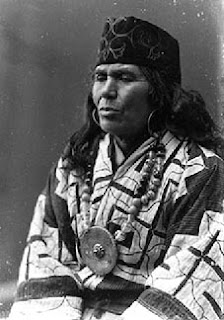 A classic Ainu man. Note the uncanny resemblance to an Amerindian. Ainus look Australoid on facial structure and Asian on genes. They are not Caucasian as many have theorized. One theory about why we have some Caucasian looking types in Asia is that the breeding together of an Australoid type with an Asian type can produce as Caucasoid type. That's just a shot in the dark, but it sounds appealing to me.
Some Amerindians, such as the Fuegians of Patagonia and the Pericu of Baja California also look like Ainu, as did the Paleoindians of the Americas, who are thought to be the first to come the continent, even before the Asian Amerindians that we know today. The Amerindians we know today may have shown up only 6,000-9,000 years ago, but they must have bred in with earlier groups.
So, we look at faces of SE Asians for Australoid structure, and we don't get much. Negritos, Melanesians, and sometimes Polynesians have Australoid faces. So do the Senoi, and possibly the Vedda (though not close to Aborigines), and we get the Tamils.
But Polynesians are Oceanians genetically, Senoi are SE Asians, and Tamils are Caucasians. Oh, what a complicated web we weave.
We don't see Australoid facial structure in SE Asians. In some, maybe we do. There are people with woolly hair and dark skin among the Taiwan aborigines and among the Malay and the Filipinos at least. These people do have some Negrito in them.
In most SE Asians, we just find that they have faces that look, well, SE Asian. It's a particular look of a face, and it's not Australoid or any such thing. I'm not sure what it resembles. It just resembles what it is - SE Asians have developed their own specific facial type, and it is what it is and you like it or you don't, but it owns itself.
If we go looking for Australoid genes in SE Asians, we pretty much come up empty handed. We find Papuan genes in some Southern Chinese, some coastal Vietnamese and some Malays and we find some sort of Australoid-looking genes in Indonesians, mostly to east.
We don't seem to find any at all in Taiwanese, Lao, Khmer, the rest of the Vietnamese, Thai or western Indonesians. Anyway, we only find a tiny amount in those groups, indicating that it's nonsense to say that they are part Australoid. It's just a tiny ancient remnant - that's all.
When we go looking at Polynesians and Micronesians, things get way more complicated. For a long time, analyses were finding that these people have up to 50% of what look like Australoid genes from Melanesia or Papua, and about 50% some kind of Austronesian genes from Taiwan.
A paper has recently come out showing that Polynesians and Micronesians are almost all Austronesian from Taiwan, and the Papuan - Melanesian connection is minor or even nonexistent. Even this paper showed that Melanesians had a heavy Papuan element, with a small Austronesian element mostly limited to eastern Indonesia. Download a paper looking at the matter on my site here.
Whatever the meaning of these studies, a close look at genetic charts tends to show Oceanians such as Micronesians, Melanesians and Polynesians lining up right alongside Papuans and Aborigines, who are themselves vastly far apart.
Clearly there is an Australoid Race. Clearly Aborigines and Papuans are too extremely distantly related aspects of that race, or maybe even separate major races on their own.
Including Melanesians is difficult. While some treatments now are finding an Oceanian Race separate from Australoids, others are finding a fairly close link between Melanesians and Australoids such as Papuans. It is probably best to say that Melanesians are Oceanians with a fairly close, but still distant, relationship to Papuans. Whatever relationship Micronesians and Polynesians have to Papuans, it is much more distant.
When we line up Aborigines to SE Asians such as Khmer, Malay, Filipinos, Thai, and Southern Chinese, we do not get a thing. The relationship is very, very distant. In many charts, the closest relative will be Polynesians (the connection above again) and then we will find Japanese, Koreans and even NE Chinese.
This is probably due to an Ainu-Gilyak Australoid element that was generalized all through NE Asia at this time.
 In my opinion, the Ainu and the Gilyak are the remains of the proto-NE Asians. They probably go back to Lake Baikal around 35,000 years ago. At some point they may have gone to Thailand, then over to Japan, and at 20,000 years ago, they must have gone to Australia. At around 16,000 years ago, Ainu types left the Altai Mountains and traveled to the Americas, possibly via a coastal route on boats. Their ancestors today, other than Fuegians and the Pericu.
Look at those really long fingers on that woman. That looks so strange.
I have seen photos of modern day Gilyaks on Sakhalin Island and they look pretty Japanese. There are projects underway to record and possibly revive their very strange language, which is somehow still alive. These were very much a fishing people, living on the coast and heavily involved in salmon fishing, drying and consumption. They also eat a lot of seaweed. The Japanese diet resembles this in some ways.
Keep in mind at proto-NE Asians (Ainu types) colonized Australia 20,000 years ago and created one of the major inputs into the Aborigines.
 A classic Aborigine, possibly from Coon in the early 20th Century. Coon made a number of good studies on Aborigines at that time. An Ainu type called Murrayians is thought to have colonized Australia 20,000 years ago. Around that time, Ainu types were in Thailand and Japan. They seem to have gone from Thailand to Japan around this time as the Jomonese, probably on boats. Surely they must have used these same boats to go to Australia.
On the way down to Australia, they seem have made up the proto-Australoids, a strange and little-known group from the Philippines that is thought to be the second arrivals after the Negritos. The description of the proto-Australoids sounds like an Ainu type, and their ancient arrival on the islands fits in well with a very early arrival in Australia.
It is true that SE Asians were probably still transitioning from Australoid to SE Asian maybe as late as 5,000 years ago, but NE Asians were making that transition only 9,000 years ago.
According the commenter, SE Asians are Australoids because that is sort of what they were 5,000 years ago. But why should we not include NE Asians, since they were Australoids only 9,000 years ago? Why not include East Indians, since they were Australoids until only 8,000 years ago?
Hell with lineage. Humans were ape-men not too long ago. Maybe even 200,000 years ago, we were still pretty apelike. Hell, Amerindians were still pretty Australoid up until 9,000 ago, and in Colombia even up until 3,000 years ago.
In the Fuegians and in the Pericu of southern Baja California, there were physically Australoid types until contact and even afterwards, even though the Pericu went extinct.
Truth is, lineage doesn't really matter. We look at things as they are today. Some things came from other things a long time, but the existing things of today are not the things that they transitioned from long ago, nor are they part of what they used to be.
Instead, they are whole new things, moving from one existence and creation to a new creation all of their own. I am not my ancestors, nor am I even part of my ancestors. But they are part of the creation story that is me and my kin, and that is a wonderful trail of a tale all on its own.
Note: Readers should carefully read the Commenting Rules before commenting to avoid having their comments edited or deleted and to avoid being banned from the site.
Updated July 12. I am republishing this post, published earlier, because I added some new photos and text to it.
We have already dealt with this issue previously on this blog, but there is need to continuously revisit old issues that do not seem to be sinking in very well after we do our revisionist and rectification work here.
For instance, I do not really care about whether or not SE Asians are part-Australoid, but among amateur anthropologists, the notion is much in vogue. Furthermore, it is regarded as given by Chinese, which unfortunately includes Southern Chinese, who by this definition, would also be part-Australoid.
This issue needs to be dealt with because it is such a widespread myth, particularly among some of our best young minds out there in popular culture. Among anthropologists, the only folks saying that SE Asians are part-Australoid are wonderful folks like Richard Lynn, who wants to "phase out" inferior races. So I'm not sure that NE Asian Supremacists should make alliance with these guys.
The truth is clear. All of Asia, as far as we can tell, was Australoid up until 9,000 years ago or so. Further, some Caucasians were part-Australoid, and there is some evidence that all of them may have been at one point.
Take a recent comment by an excellent mind in my comments section, who states that all SE Asians are Australoids based on their lineage.
First of all, lineage doesn't really mean crap. In the lineage of Caucasians is African, Asian and probably Australoid, going back 45,000 years or so, and maybe more so in between, since India seems to be continuously injecting itself into the Caucasian mix from 10,000-45,000 years ago, and India was Australoid until 8,000 years ago, when it finally transitioned to Caucasian.
In fact, Caucasians may have been made up one part African from Masai and Tutsi-type Central African stock, and two parts NE Asian, which at 45,000 years ago was probably an Australoid that looked something like an Ainu. So Caucasians themselves are probably two parts Australoid in their mix going way, way back.
There are different ways of doing race, in places where anti-racist nuts have not outlawed it or shamed it out altogether. We can look at facial structure, or we can look at genes. There are no other ways of doing it that make sense.
Facial structure is a favorite among White racists, but otherwise it's ok. White racists despise genes, because too many other "non-White" Caucasians end up being too close to their precious European White Glory.
Lots of people hate genes because they give funny results. The exalted Hong Kong Chinese make up a taut subrace with the unknown Taiwanese Ami and the downtrodden and abused Filipinos. We can't have that.
Let's do faces instead, or skin color, the craziest of them all. We do skin color and we miss tight genetic units like Algerians and Nubians, one White and one Black group that are so closely related they can easily be called a minor race and even a closely-knit genetic family.
Faces are interesting, but genes are sort of where it's at in a way. Negritos and Ainu go to the surrounding Asians on genes, but to Australoids on facial structure. So where do we toss em? Fuegian Amerindians go Australoid on facial structure but Amerindian on genes, so which bin? I'm inclined to toss Fuegians into Amerindians on mere sense grounds, since saying they are Australoids lost in America is just too weird.
 A classic Ainu man. Note the uncanny resemblance to an Amerindian. Ainus look Australoid on facial structure and Asian on genes. They are not Caucasian as many have theorized. One theory about why we have some Caucasian looking types in Asia is that the breeding together of an Australoid type with an Asian type can produce as Caucasoid type. That's just a shot in the dark, but it sounds appealing to me.
Some Amerindians, such as the Fuegians of Patagonia and the Pericu of Baja California also look like Ainu, as did the Paleoindians of the Americas, who are thought to be the first to come the continent, even before the Asian Amerindians that we know today. The Amerindians we know today may have shown up only 6,000-9,000 years ago, but they must have bred in with earlier groups.
So, we look at faces of SE Asians for Australoid structure, and we don't get much. Negritos, Melanesians, and sometimes Polynesians have Australoid faces. So do the Senoi, and possibly the Vedda (though not close to Aborigines), and we get the Tamils.
But Polynesians are Oceanians genetically, Senoi are SE Asians, and Tamils are Caucasians. Oh, what a complicated web we weave.
We don't see Australoid facial structure in SE Asians. In some, maybe we do. There are people with woolly hair and dark skin among the Taiwan aborigines and among the Malay and the Filipinos at least. These people do have some Negrito in them.
In most SE Asians, we just find that they have faces that look, well, SE Asian. It's a particular look of a face, and it's not Australoid or any such thing. I'm not sure what it resembles. It just resembles what it is - SE Asians have developed their own specific facial type, and it is what it is and you like it or you don't, but it owns itself.
If we go looking for Australoid genes in SE Asians, we pretty much come up empty handed. We find Papuan genes in some Southern Chinese, some coastal Vietnamese and some Malays and we find some sort of Australoid-looking genes in Indonesians, mostly to east.
We don't seem to find any at all in Taiwanese, Lao, Khmer, the rest of the Vietnamese, Thai or western Indonesians. Anyway, we only find a tiny amount in those groups, indicating that it's nonsense to say that they are part Australoid. It's just a tiny ancient remnant - that's all.
When we go looking at Polynesians and Micronesians, things get way more complicated. For a long time, analyses were finding that these people have up to 50% of what look like Australoid genes from Melanesia or Papua, and about 50% some kind of Austronesian genes from Taiwan.
A paper has recently come out showing that Polynesians and Micronesians are almost all Austronesian from Taiwan, and the Papuan - Melanesian connection is minor or even nonexistent. Even this paper showed that Melanesians had a heavy Papuan element, with a small Austronesian element mostly limited to eastern Indonesia. Download a paper looking at the matter on my site here.
Whatever the meaning of these studies, a close look at genetic charts tends to show Oceanians such as Micronesians, Melanesians and Polynesians lining up right alongside Papuans and Aborigines, who are themselves vastly far apart.
Clearly there is an Australoid Race. Clearly Aborigines and Papuans are too extremely distantly related aspects of that race, or maybe even separate major races on their own.
Including Melanesians is difficult. While some treatments now are finding an Oceanian Race separate from Australoids, others are finding a fairly close link between Melanesians and Australoids such as Papuans. It is probably best to say that Melanesians are Oceanians with a fairly close, but still distant, relationship to Papuans. Whatever relationship Micronesians and Polynesians have to Papuans, it is much more distant.
When we line up Aborigines to SE Asians such as Khmer, Malay, Filipinos, Thai, and Southern Chinese, we do not get a thing. The relationship is very, very distant. In many charts, the closest relative will be Polynesians (the connection above again) and then we will find Japanese, Koreans and even NE Chinese.
This is probably due to an Ainu-Gilyak Australoid element that was generalized all through NE Asia at this time.
 In my opinion, the Ainu and the Gilyak are the remains of the proto-NE Asians. They probably go back to Lake Baikal around 35,000 years ago. At some point they may have gone to Thailand, then over to Japan, and at 20,000 years ago, they must have gone to Australia. At around 16,000 years ago, Ainu types left the Altai Mountains and traveled to the Americas, possibly via a coastal route on boats. Their ancestors today, other than Fuegians and the Pericu.
Look at those really long fingers on that woman. That looks so strange.
I have seen photos of modern day Gilyaks on Sakhalin Island and they look pretty Japanese. There are projects underway to record and possibly revive their very strange language, which is somehow still alive. These were very much a fishing people, living on the coast and heavily involved in salmon fishing, drying and consumption. They also eat a lot of seaweed. The Japanese diet resembles this in some ways.
Keep in mind at proto-NE Asians (Ainu types) colonized Australia 20,000 years ago and created one of the major inputs into the Aborigines.
 A classic Aborigine, possibly from Coon in the early 20th Century. Coon made a number of good studies on Aborigines at that time. An Ainu type called Murrayians is thought to have colonized Australia 20,000 years ago. Around that time, Ainu types were in Thailand and Japan. They seem to have gone from Thailand to Japan around this time as the Jomonese, probably on boats. Surely they must have used these same boats to go to Australia.
On the way down to Australia, they seem have made up the proto-Australoids, a strange and little-known group from the Philippines that is thought to be the second arrivals after the Negritos. The description of the proto-Australoids sounds like an Ainu type, and their ancient arrival on the islands fits in well with a very early arrival in Australia.
It is true that SE Asians were probably still transitioning from Australoid to SE Asian maybe as late as 5,000 years ago, but NE Asians were making that transition only 9,000 years ago.
According the commenter, SE Asians are Australoids because that is sort of what they were 5,000 years ago. But why should we not include NE Asians, since they were Australoids only 9,000 years ago? Why not include East Indians, since they were Australoids until only 8,000 years ago?
Hell with lineage. Humans were ape-men not too long ago. Maybe even 200,000 years ago, we were still pretty apelike. Hell, Amerindians were still pretty Australoid up until 9,000 ago, and in Colombia even up until 3,000 years ago.
In the Fuegians and in the Pericu of southern Baja California, there were physically Australoid types until contact and even afterwards, even though the Pericu went extinct.
Truth is, lineage doesn't really matter. We look at things as they are today. Some things came from other things a long time, but the existing things of today are not the things that they transitioned from long ago, nor are they part of what they used to be.
Instead, they are whole new things, moving from one existence and creation to a new creation all of their own. I am not my ancestors, nor am I even part of my ancestors. But they are part of the creation story that is me and my kin, and that is a wonderful trail of a tale all on its own.
Note: Readers should carefully read the Commenting Rules before commenting to avoid having their comments edited or deleted and to avoid being banned from the site.
Subscribe to:
Posts (Atom)