Showing posts with label Papuans. Show all posts
Showing posts with label Papuans. Show all posts
Wednesday, December 08, 2010
Des Soldats Indonésiens Torturent des Papous
I am looking for translators to translate this post into French, Italian, German, Norwegian and Tagalog. Email me if you are interested.
Spanish translation (en Español). Italian translation (traduzione in Italiano). Norwegian translation (på norsk).
This is the French version of the Indonesian Soldiers Torture Papuan Men post.
Ce sont les images extrêmement choquantes de soldats indonésiens torturant un Papou et son père en Nouvelle-Guinée occidentale.
L’Indonésie a volé la Nouvelle-Guinée occidentale aux Papous en 1965 et a mené une guerre génocidaire et raciste contre les Papous depuis. Les soldats sont extrêmement racistes et considèrent les Papous à peine mieux que des animaux.
Les Papous essaient de se battre en utilisant des armes primitives mais ils ne font pas le poids face à une armée moderne. L’impérialisme américain a soutenu les Indonésiens dans cette guerre car les sociétés américaines veulent exploiter les ressources naturelles de Papouasie.
La scène a été prise à l’aide d’un téléphone portable par un des soldats engagés dans une opération militaire dans la région du Puncak Jaya dans les hauts plateaux de Nouvelle-Guinée occidentale.
Les opérations ont été lancées après que le Mouvement de Libération Papoue, un groupe armé cherchant à s’affranchir du colonialisme indonésien, mais l’activité des troupes indonésiennes consiste principalement en des actes de torture, des viols et des meurtres de civils comme cela a toujours été le cas.
Il s’agit apparemment d’« images trophée ». La vidéo n’est qu’un extrait d’une plus longue vidéo montrant les deux hommes torturés. Dans la version complète, le vieil homme est dévêtu, un sac sur la tête et un bâton incandescent est mis sur ses testicules tandis qu’il hurle à la mort. Le jeune homme a un couteau sur son visage.
Les renseignements sur l’identité des victimes sont difficiles à obtenir puisque l’on se trouve dans une zone militaire interdite d’accès dans laquelle les journalistes ne peuvent pas pénétrer. Toutefois, le vieil homme a été porté disparu et est probablement mort, tandis que le jeune homme a été relâché.
Les troupes indonésiennes ont tué, torturé et violé des Papous en toute impunité depuis 1963. Les victimes les plus jeunes n’avaient que 3 ans.
Pendant des années, les soldats indonésiens ont pris des photos - maintenant des films - comme trophée pour leurs exactions sur des Papous tués et violés. Ils montrent ces photos et vidéos aux Papous pour les humilier.
Le film est apparu très récemment, le 20 octobre 2010, et a provoqué quelques remous médiatiques.


Tuesday, December 07, 2010
Truppe Indonesiane Torturano due Papuani
I am looking for translators to translate this post into German, Norwegian and Tagalog. Email me if you are interested.
Spanish translation (en Español). French translation (en Français). Norwegian translation (på norsk).
This is the Italian translation of the Indonesian Soldiers Torture Papuan Men post. Translator: Paolo from Trieste.
Queste immagini sono solo un breve estratto di un filmato sconvolgente: la tortura di due papuani, padre e figlio, vittime delle truppe indonesiane.
Ci troviamo nella Papuasia dell'ovest, teatro dal 1963 di inaudite, infami atrocità. Gli indonesiani si sono accaniti su quella povera popolazione con una ferocia degna degli antichi conquistadores.
I papuani sono trattati alla stregua di bestie: vengono uccisi, torturati e stuprati persino i bambini (...anche se di solo 3 anni...).
I carnefici hanno la certezza di non essere puniti. Occupata definitivamente nel 1965, a tutt'oggi si contano più di 100.000 morti. E' un genocidio.
Come può resistere una popolazione dotata solo di armi primitive contro un esercito moderno che gode pure del supporto delle multinazionali USA interessate al controllo delle materie prime della zona? Ancora una volta, complimenti all'imperialismo americano, eh ?
Il video in questione è stato realizzato nel mese di maggio 2010 nella regione del Punkak Jaya, nella catena centrale della Papua Nuova Guinea dell'ovest, durante un'operazione militare contro il 'Movimento di Liberazione Papuano' (flebile resistenza al colonialismo indonesiano).
Nell'ottica della propaganda di guerra, un soldato filma le torture a due prigionieri.
L'anziano viene denudato, una borsa premuto sulla faccia, gli arrostiscono le palle con un ferro rovente: le sue urla d'agonia fanno accapponare la pelle! Il giovane viene schiaffeggiato ripetutamente mentre un soldato 'gioca' sadisticamente sulla sua faccia con un coltellaccio.
Malgrado la stretta censura governativa, si è venuti a conoscenza che il giovane è stato successivamente liberato (e forse bisognoso di plastica facciale...) mentre del padre si è persa ogni traccia.
L'uso dei media per intimidire ed umiliare una popolazione da sottomettere è un classico : se nel passato gli indonesiani non hanno esitato a diffondere bieche immagini fotografiche di stupri e morte, nell'era di internet sono d'obbligo i video, nuovi trofei di guerra da esibire a tutto il mondo.
Diffuso poco tempo fa, il 20 ottobre scorso, questo video ha fatto immediatamente scalpore.
Thursday, November 25, 2010
Indonesian Soldiers Torture Papuan Men
I am looking for translators to translate this post into German and Tagalog. Email me if you are interested.
Spanish translation (en Español). Italian translation (traduzione in Italiano). French translation (en Français). Norwegian translation (på norsk).
This is extremely shocking footage of Indonesian soldiers in West Papua torturing a Papuan man and his father.
Indonesia stole West Papua from the Papuans in 1965, and has waged a genocidal and racist war against the Papuans ever since, a war that has killed 100,000 Papuans. Soldiers are extremely racist and view Papuans as little more than animals.
Papuans try to fight back using very primitive weapons, but they are no match for the modern Indonesian military. US imperialism has backed the Indonesians to the hilt in this war because US corporations want to exploit various raw materials in Papua.
The footage was filmed on a cellphone in May by one of the soldiers taking part in a military operation in the Punkak Jaya region of the Central Highlands of West Papua. The operation was launched against the Free Papua Movement, an armed group seeking freedom from Indonesian colonialism, but the troops are mostly just torturing, raping and murdering civilians like they always do.
It is apparently "trophy footage." This video is just a small part of a much larger video that shows the two men being tortured. In the bigger video, the older man is stripped naked, has a bag put over his head and has a burning stick applied to his genitals while he screams in agony. The young man has a knife held to his face.
Details of who the victims are hard to come by since the area is a closed military zone, and journalists are banned from the area. However, the older man is missing and probably dead, while the young man has been released.
Indonesian troops have been killing, torturing and raping Papuans with impunity since 1963. Victims have been as young as 3 years old.
For many years, Indonesian troops have been taking trophy photos, now escalating to films, of Papuans being killed and raped. They show this media to Papuans in order to humiliate them.
The footage appeared just recently, on October 20, 2010 and caused a bit of a media stir.
Wednesday, November 19, 2008
The Peopling of Indonesia
I am republishing this post because I have significantly reworked the genetics of the Indonesians. Instead of being mostly Austronesians from Taiwan, I now say they are mostly related to an ancient Melanesian Dai group from SE China that came 10-20,000 years ago. This group imposed itself on the original people, who were Papuans.
Later, Austronesians came through, leaving languages but only some genes. The Indonesian type was formerly generalized throughout SE Asia from 2-4,000 years ago and is known as an Ancient SE Asian. This type is primarily Mongoloid but has strong Australoid elements.
The breakdown of Indonesians is approximately 70% Ancient Dai (Melanesian), 15% Austronesians from Taiwan (probably mostly Paiwan and Ami) and 15% Papuan.
The ancient Dai appear to have undergone the same progression towards Mongoloid as occurred with Melanesians throughout Inland SE Asia. In island SE Asia (Melanesia) and the East of Indonesia, this progression was much less complete, so people still have strong Melanesian elements. The degree to which some Melanesians resemble Negritos is rather striking.
To sum up, the new data indicates that most Indonesians are not related primarily to Taiwanese aborigines as originally thought. Instead they are related to Daics from far SE China who left their homeland during post-glacial flooding that occurred after 18,000 years ago. Only 20% of the Indonesian line comes from recent (past 4,000 years) Taiwanese aborigine immigrants.
The prehistory of Indonesia is an interesting question, but it is little studied.
 Typical Indonesian men. The one on the left looks very Chinese, or Filipino. The one on the right looks a little different. Indonesians are dark, but the place is right on the equator, so this is to be expected.
Human sites have been found as far back as 33,000 years in the far east Maluku Islands (or Moluccan Islands), but these people are normally referred to as Melanesians. Actually, I think that they were Papuans. Very early man, Homo Erectus, has been found in the islands dating way back.
A multiregional theory has been suggested for the evolution of man in Indonesia, China and maybe other areas. This theory has been rejected, however there may be some continuity in China with older forms dating back 120,000 years or so. The Chinese, the Japanese and now the Indonesians all want to say they came from a different monkey.
The theory is also very popular with White Nationalists who are extremely insulted by the idea of being descended from African Blacks. In Indonesia and China, these ideas have more to do with the spread of idiotically antiscientific nationalist-based theories than anything else.
In Indonesia, the nation's top archaeologist deliberately destroyed bones of Homo Florensis recently in spite over the rejection of his pet theory, that the Homo Erectus relative that lived in modern times are just modern humans who are microencephalic. This theory seems crazy, but is making the rounds in peer-reviewed journals nevertheless.
Nationalism and science has never worked well, with some particularly gruesome results especially in the past century. Florensis is a tiny midget of an early man who is a different species from us. They may have lived up until 600 years ago but the hard evidence so far shows they lived until 13,000 years ago at the latest. I believe they lived until the arrival of the Europeans. It is possible some may yet exist to this day.
There are a lot of questions about whether or not Florensis and locals bred in. Some of the locals are very short and some even think they may have Florensis like features, though the question of inter-species breeding makes little sense. Locals say that the Little People are their ancestors.
The Little People would come to their villages and hide in the forest watching them. Locals would leave food for the Little People in baskets and the Little People would come when no one was around and take the food - they were described as very shy. It is amazing that such a primitive man could live in such proximity to modern Homo without genocidal results.
In the past, contacts between more modern civilizations and more primitive ones usually had genocidal results. Examples include Indonesia, Australia, New Zealand, Japan, Korea, Africa, the Americas, Siberia, and probably other places.
Before Florensis, there is Java Man, who dates back possibly to 2 million years. It is due to the prominence of Java Man that the Indonesian "scientists" have indulged in their childish and petty behavior. Actually, the Indonesian case above is more complicated than that - the destroyer of the skulls is the grand old man of Indonesian archeology and he cannot be touched.
There are a number of younger archaeologists there who think the man is an old fool, which he is, but no can do a thing about him.
The question of Homo Erectus being put aside, we now turn to the development of modern Homo in Indonesia. Here, very little is known for some reason, but we do have that 33,000 yr old find in the Malukus. These people are called Melanesians for lack of a better word, but it also appears that there were cultural contacts with Australians across the straights. I believe that a better term for these early people is Papuans.
At this time, Melanesians were probably generalized all throughout SE Asia.
Sometime around 10-15,000 years ago, these Papuans populate most of the Mulukus. The nature of the aforementioned contacts with the Australians, genetic or otherwise, is not known, but that such early modern man had such excellent boats is stunning. Much is made by racists of the primitiveness and low IQ's of Aborigines.
However, we should note the profound cultural achievement it took to make those boats to get to Australia in the first place. But we had great boats when we first left the African Horn at Somalia and Djibouti, went to Yemen and moved along the coast all the say to SE Asia, stopping along the way in Iran, Yemen, India, Pakistan, Sri Lanka, Burma, Thailand, Indonesia, New Guinea, Melanesia and Australia.
There is a chain of Negritos in every one of these places, probably the last remainders of the first modern men that left Africa 60-70,000 years. In Australia, the Negritos went to Aborigine Major Race; in Papua, they went to the Papuan Major Race, in Melanesia to the Melanesian Minor Race. However, recent data suggests that the Melanesian race is extremely diverse, so it may have to be re-evaluated.
Some analyses show Melanesians clustering fairly close to Papuans, yet others show Papuans as a vast major race, tied with Aborigines as the most diverse on Earth after Africans. They are also some of the furthest away from Africans.
Whites are more closely related to Africans than Papuans are, yet everyone from Afrocentrists to White Nationalists wants to say Papuans are Black people. In the North, they went on to form the early basis for all members of the Asian Macro-race today.
The standard history is that some unknown Melanesians, about which we know little, were the original inhabitants of Indonesia. Recent research sheds some light on the genesis of these Melanesians.
Turner, a specialist in teeth, using dental morphological traits, hypothesized that two migrations originated from central China about 20-30,000 YBP (years before present).
One group, the Sinodonts, expanded northward into China, Siberia and across the Bering land bridge to the New World. The second group, the Sundadonts, moved southward into Southeast Asia and Indonesia, and later through Melanesia, Micronesia, and Polynesia.
This is probably the group that gave rise to the Melanesians.
But the picture is more complicated than that.
Indonesians were settled independently by ancient Dai. These Dai came from from Hainan and Guangxi in far southern China about 10-20,000 YBP. They may have left due to rising sea levels that flooded their lands. The ancient Dai must have looked like Melanesians.
The people most closely resembling the ancient Dai are the Taiwan aborigines. It is true that the Indonesians do not much resemble the Taiwan aborigines genetically, and their genetic structure in general is quite a bit different from Filipinos.
However, this study does not explain how Indonesians came to speak Austronesian languages obviously derived ultimately from Taiwan.
It is clear to me that when the Austronesians pushed through Indonesia several thousand years ago, the locals adopted the Austronesian tongues of the Austronesian colonizers, abandoning whatever tongues they were speaking at the time (I figure Papuan languages).
Recent tests indicate that the Indonesians derive 71% from the ancient Dai, 14% from the Taiwan aborigines (Austronesians) and 15% from Papuans. This study looks at Y chromosomes. 10-20,000 years ago, these ancient Dai went from Hainan and Guangxi (their homeland) to Taiwan to become the Taiwan aborigines and also on to Indonesia in two separate waves.
They probably genetically swamped and colonized the native peoples, who were probably Papuans.
Today, only the Malukus identify as Melanesians, despite the fact that there are Melanesians on Alor and in other places. On Timor, Sumba and Flores, there are people who are at least part-Melanesian who do not really identify as Melanesian. Some of these people are up to 80% Melanesian, as in Alor.
The standard history of the rest of the islands, such as Sulawesi, Sumatra, Bali is that Austronesians came 4,000 years ago and pushed the native Melanesians to the east. However, this standard history must be wrong. Instead of pushing Melanesians east, they bred in with them.
Most Indonesian is an example of a race that used be common all through SE Asia, including Vietnam - the Ancient SE Asian Race. This race was widespread throughout SE Asia 2-4,000 years ago. It is a Mongoloid with considerable Australoid admixture.
 Tsunami victims in Aceh on Sumatra. They are quite dark as you can see, but that is probably a pigmentation process to enable females to store folic acid for pregnancy in order to give birth to viable infants. Protection against sunburn is an interesting theory, but sunburn, even melanoma, does not kill you.
They are members of the Island SE Asian Race, along with the Balinese pictured below. Like the Balinese, they may have an origin in part with the Paiwan aborigines of Taiwan.
The Sumba and probably all of the other Lesser Sunda Islands are inhabited by people who are a mixture between Austronesians from Taiwan and native Melanesians - Ancient SE Asians, as described above. Timor also has Papuans and Polynesians. Early man arrived on Timor as early as 40,000 years ago. These people must have been Papuans.
The Mulukus such as Babar and Ambon are inhabited by mixtures of Austronesians from Taiwan, Papuans in the case of Ambon and Melanesians in the case of Babar.
4,000 YBP, the Austronesians arrived in Indonesia from Taiwan. Mostly, these were the Ami, but there is a possibility that other Taiwanese aborigines were also, in particular, the Paiwan.
These were the Austronesians, the greatest mariners of all time, who settled Philippines, Indonesia, coastal New Guinea, Melanesia, Micronesia and Polynesia. There are even said to have moved into mainland SE Asia, particularly Malaysia. In that case, they probably went to Sumatra first and then moved across the water to Malaysia.
 These Indonesian Muslim women praying look very much like Malays. It is not known where they are from. They may be members of the Malay Race found on Java and Borneo in Indonesia described at the end of the post.
They even seem to be a major component of the Vietnamese. Everywhere they went, the Austronesians brought a cultural revolution with them, often upgrading existing cultures, certainly so in the case of New Guinea.
Austronesians arrived in Indonesia at least 4,000 years ago by boat, probably from the Philippines, where they already probably had a mature settlement. However, the Austronesian show up in Timor as early as 5,000 years ago, so 4,000 years BP may be too late.
Next, at least on Timor, and probably throughout Indonesia, a wave of proto-Malays moved through. A group settled Bali 5,000 years ago who may have been proto-Malays. Proto-Malays are also important in the settlement of the Philippines and Malaysia.
The proto-Malays who settled in the Philippines were said to be short and very hairy. The hairiness is odd for people living in a hot climate. If this description is true, I suggest that the proto-Malay may have been an Ainu-like people, the proto-NE Asians. A Southern origin is possible for the Ainu. The pre-Ainu, the Jomon, are said to have origins in Thailand 18,000 years ago. They got on boats and sailed to Japan.
These hairy proto-Malays may have been related to the pre-Jomon in Thailand long ago. Proto-Malays show up in the Philippines over 5000 years BP, before the arrival of the Austronesians. The proto-Malays who settled the Philippines and Indonesia are said to have had an origin in South China and inland SE Asia.
However, in Malaysia, the proto-Malay are said to have been created in Malaysia 3000 years ago as Austronesians bred in with existing Senoi, an Australoid or Negrito like people. The Proto-Malays are poorly understood, and some of what is said about them is contradictory.
Austronesians show up in Sulawesi, Java, the Mulukus and Borneo 3,500 years ago. Austronesians moved from Borneo to Sumatra 2,500 years ago, and from there up into Malaysia to become a component of the Malay Race.
 A beautiful woman on Samosir Island on Sumatra. She may be a Toba Batak, who are members of the Micronesian Race. Unless I am hallucinating, I think that many Micronesians look something like this. A possible explanation is that the Batak are the remains of those Austronesian-Melanesian mixes who populated Polynesia and then left Polynesia to populate Micronesia, but the situation is quite confused.
In the background is one of the famous Toba Batak bark houses. She is in traditional dress. Note the resemblance to a Filipina.
The Batak, like the Sea Dayak of northern Borneo and the Nesiot and Igorot of the Philippines, are linked to the first Austronesian wave out of Taiwan 5,000 years ago. This group is also linked to the Paiwan tribe on Taiwan.
A cultural revolution in Indonesia called Đông Sơn was paralleled by similar developments throughout SE Asia. This culture was centered in the Red River Valley of northern Vietnam and northward in southern Kwangzi and Kwangtung of China, while being generalized throughout Indonesia, showing up about 3,000 years ago. Originally, the Đông Sơn were said to be Austronesians, but the latest thinking is that this is an ancient Tai group.
Wet-rice cultivation spread throughout the islands with Đông Sơn, but the native Melanesians were already engaging in wet-rice cultivation an incredible 10,000 years ago, making Indonesia one of the earliest sites for agriculture on Earth.
The Đông Sơn culture was developing in Vietnam from 2,200-2,800 YBP.
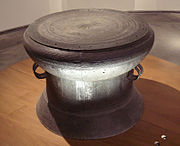
The Đông Sơn kept buffaloes and pigs, fished, grew rice and, in a clue to their Austronesian nature, sailed in long dugout canoes. An Iron Age people, they utilized metallurgy to make fine bronze objects, including drums and figurines.
Racially, the Đông Sơn peoples belonged to Indonesian or Ancient Southeast Asian group - a Southern Mongoloid with strong Australoid elements (Cuong, 1996).
Đông Sơn also had elements of Dai culture from Yunnan and Laos, Khmer culture of Cambodia, Tibeto-Burman culture, and the prehistoric Plain of Jars culture in Laos. So all of these elements from mainland SE Asia and Southern China went into the stew that became Indonesian culture.
Now, Indonesians are members of either the SE Asian Major Race, the Oceanian Major Race or the Papuan Major Race. For the most part, they seem to be some sort of a mixture between ancient Daic Melanesians and Austronesian Chinese (Taiwanese).
Haplogroups C, E and F in Figure 1 here, seem to have a southern origin. These strains are apparent on a minor scale in Java, Borneo and Sulawesi. But in Southern Borneo, they reach levels up to 40%. Haplogroups G, H and L are also associated with Taiwan, the Philippines and to a lesser extent South China.
L is clearly the Ami of Taiwan but G and H are less well-understood. This paper suggests that they have a southern (Melanesian) genesis, but that does not make much sense. H is present at high levels in the Taiwanese Atayal, Bunum and Paiwan, and G is present at high levels in the Bunum and the Paiwan. G is at even higher levels in Javans.
 Some beautiful, typical, Indonesian women with the usual phenotype. Note the resemblance with Thais, Filipinas, and possibly Khmers. I believe that these women may be Balinese, but correct me if I am wrong. If so, they are members of the Island SE Asian Race that may have its origins in the Paiwan aborigines of Taiwan.
On a principle coordinates map here (Figure 4), Indonesians cluster close to Filipinos, the Ami of Taiwan and Southern Chinese.
That paper, referenced in the several paragraphs above, may be downloaded on this site here.
Indonesians today constitute several races. Papuans and Melanesians were mentioned above. The Toba Batak are Micronesians, but how they ended up in northern Sumatra is a mystery.
Indonesians on Java and northern Borneo are members of the Malay Race, also found in Malaysia. Indonesians from Sumatra, Bali and the Sea Dayak of northern Borneo, along with the Paiwan aborigines from Taiwan, are members of the Island SE Asian Race.
The Sea Dayak are also linked anthropologically with the first wave of Austronesians out of Taiwan 5,000 years ago, along with the Nesiot and Igorot in the Philippines. The suggestion is that the first wave of Austronesians may have been related to the Paiwan tribe.
This clustering is odd, and suggests that the Paiwan, in addition to the Ami, may have been among the Austronesian seafarers who populated Indonesia.
 Click to view details. Map showing the Paiwan, Atayal, Bunum and Ami aborigines of Taiwan. The Paiwan seem to have a relationship with the Sea Dayak of North Borneo, the Balinese, and the Sumatrans. This indicates that the Paiwan, located on the lower right on the map, may have helped to settle Indonesia as Austronesians along with the Ami who are usually associated with Austronesians. Note that both the Paiwan and the Ami were properly positioned to colonize island SE Asia.
The Indonesians of Sulawesi, the Lesser Sundas and Borneo are members of the mainstream Indonesian Race.
Note: Readers should carefully read the Commenting Rules before commenting to avoid having their comments edited or deleted and to avoid being banned from the site.
Later, Austronesians came through, leaving languages but only some genes. The Indonesian type was formerly generalized throughout SE Asia from 2-4,000 years ago and is known as an Ancient SE Asian. This type is primarily Mongoloid but has strong Australoid elements.
The breakdown of Indonesians is approximately 70% Ancient Dai (Melanesian), 15% Austronesians from Taiwan (probably mostly Paiwan and Ami) and 15% Papuan.
The ancient Dai appear to have undergone the same progression towards Mongoloid as occurred with Melanesians throughout Inland SE Asia. In island SE Asia (Melanesia) and the East of Indonesia, this progression was much less complete, so people still have strong Melanesian elements. The degree to which some Melanesians resemble Negritos is rather striking.
To sum up, the new data indicates that most Indonesians are not related primarily to Taiwanese aborigines as originally thought. Instead they are related to Daics from far SE China who left their homeland during post-glacial flooding that occurred after 18,000 years ago. Only 20% of the Indonesian line comes from recent (past 4,000 years) Taiwanese aborigine immigrants.
The prehistory of Indonesia is an interesting question, but it is little studied.
 Typical Indonesian men. The one on the left looks very Chinese, or Filipino. The one on the right looks a little different. Indonesians are dark, but the place is right on the equator, so this is to be expected.
Human sites have been found as far back as 33,000 years in the far east Maluku Islands (or Moluccan Islands), but these people are normally referred to as Melanesians. Actually, I think that they were Papuans. Very early man, Homo Erectus, has been found in the islands dating way back.
A multiregional theory has been suggested for the evolution of man in Indonesia, China and maybe other areas. This theory has been rejected, however there may be some continuity in China with older forms dating back 120,000 years or so. The Chinese, the Japanese and now the Indonesians all want to say they came from a different monkey.
The theory is also very popular with White Nationalists who are extremely insulted by the idea of being descended from African Blacks. In Indonesia and China, these ideas have more to do with the spread of idiotically antiscientific nationalist-based theories than anything else.
In Indonesia, the nation's top archaeologist deliberately destroyed bones of Homo Florensis recently in spite over the rejection of his pet theory, that the Homo Erectus relative that lived in modern times are just modern humans who are microencephalic. This theory seems crazy, but is making the rounds in peer-reviewed journals nevertheless.
Nationalism and science has never worked well, with some particularly gruesome results especially in the past century. Florensis is a tiny midget of an early man who is a different species from us. They may have lived up until 600 years ago but the hard evidence so far shows they lived until 13,000 years ago at the latest. I believe they lived until the arrival of the Europeans. It is possible some may yet exist to this day.
There are a lot of questions about whether or not Florensis and locals bred in. Some of the locals are very short and some even think they may have Florensis like features, though the question of inter-species breeding makes little sense. Locals say that the Little People are their ancestors.
The Little People would come to their villages and hide in the forest watching them. Locals would leave food for the Little People in baskets and the Little People would come when no one was around and take the food - they were described as very shy. It is amazing that such a primitive man could live in such proximity to modern Homo without genocidal results.
In the past, contacts between more modern civilizations and more primitive ones usually had genocidal results. Examples include Indonesia, Australia, New Zealand, Japan, Korea, Africa, the Americas, Siberia, and probably other places.
Before Florensis, there is Java Man, who dates back possibly to 2 million years. It is due to the prominence of Java Man that the Indonesian "scientists" have indulged in their childish and petty behavior. Actually, the Indonesian case above is more complicated than that - the destroyer of the skulls is the grand old man of Indonesian archeology and he cannot be touched.
There are a number of younger archaeologists there who think the man is an old fool, which he is, but no can do a thing about him.
The question of Homo Erectus being put aside, we now turn to the development of modern Homo in Indonesia. Here, very little is known for some reason, but we do have that 33,000 yr old find in the Malukus. These people are called Melanesians for lack of a better word, but it also appears that there were cultural contacts with Australians across the straights. I believe that a better term for these early people is Papuans.
At this time, Melanesians were probably generalized all throughout SE Asia.
Sometime around 10-15,000 years ago, these Papuans populate most of the Mulukus. The nature of the aforementioned contacts with the Australians, genetic or otherwise, is not known, but that such early modern man had such excellent boats is stunning. Much is made by racists of the primitiveness and low IQ's of Aborigines.
However, we should note the profound cultural achievement it took to make those boats to get to Australia in the first place. But we had great boats when we first left the African Horn at Somalia and Djibouti, went to Yemen and moved along the coast all the say to SE Asia, stopping along the way in Iran, Yemen, India, Pakistan, Sri Lanka, Burma, Thailand, Indonesia, New Guinea, Melanesia and Australia.
There is a chain of Negritos in every one of these places, probably the last remainders of the first modern men that left Africa 60-70,000 years. In Australia, the Negritos went to Aborigine Major Race; in Papua, they went to the Papuan Major Race, in Melanesia to the Melanesian Minor Race. However, recent data suggests that the Melanesian race is extremely diverse, so it may have to be re-evaluated.
Some analyses show Melanesians clustering fairly close to Papuans, yet others show Papuans as a vast major race, tied with Aborigines as the most diverse on Earth after Africans. They are also some of the furthest away from Africans.
Whites are more closely related to Africans than Papuans are, yet everyone from Afrocentrists to White Nationalists wants to say Papuans are Black people. In the North, they went on to form the early basis for all members of the Asian Macro-race today.
The standard history is that some unknown Melanesians, about which we know little, were the original inhabitants of Indonesia. Recent research sheds some light on the genesis of these Melanesians.
Turner, a specialist in teeth, using dental morphological traits, hypothesized that two migrations originated from central China about 20-30,000 YBP (years before present).
One group, the Sinodonts, expanded northward into China, Siberia and across the Bering land bridge to the New World. The second group, the Sundadonts, moved southward into Southeast Asia and Indonesia, and later through Melanesia, Micronesia, and Polynesia.
This is probably the group that gave rise to the Melanesians.
But the picture is more complicated than that.
Indonesians were settled independently by ancient Dai. These Dai came from from Hainan and Guangxi in far southern China about 10-20,000 YBP. They may have left due to rising sea levels that flooded their lands. The ancient Dai must have looked like Melanesians.
The people most closely resembling the ancient Dai are the Taiwan aborigines. It is true that the Indonesians do not much resemble the Taiwan aborigines genetically, and their genetic structure in general is quite a bit different from Filipinos.
However, this study does not explain how Indonesians came to speak Austronesian languages obviously derived ultimately from Taiwan.
It is clear to me that when the Austronesians pushed through Indonesia several thousand years ago, the locals adopted the Austronesian tongues of the Austronesian colonizers, abandoning whatever tongues they were speaking at the time (I figure Papuan languages).
Recent tests indicate that the Indonesians derive 71% from the ancient Dai, 14% from the Taiwan aborigines (Austronesians) and 15% from Papuans. This study looks at Y chromosomes. 10-20,000 years ago, these ancient Dai went from Hainan and Guangxi (their homeland) to Taiwan to become the Taiwan aborigines and also on to Indonesia in two separate waves.
They probably genetically swamped and colonized the native peoples, who were probably Papuans.
Today, only the Malukus identify as Melanesians, despite the fact that there are Melanesians on Alor and in other places. On Timor, Sumba and Flores, there are people who are at least part-Melanesian who do not really identify as Melanesian. Some of these people are up to 80% Melanesian, as in Alor.
The standard history of the rest of the islands, such as Sulawesi, Sumatra, Bali is that Austronesians came 4,000 years ago and pushed the native Melanesians to the east. However, this standard history must be wrong. Instead of pushing Melanesians east, they bred in with them.
Most Indonesian is an example of a race that used be common all through SE Asia, including Vietnam - the Ancient SE Asian Race. This race was widespread throughout SE Asia 2-4,000 years ago. It is a Mongoloid with considerable Australoid admixture.
 Tsunami victims in Aceh on Sumatra. They are quite dark as you can see, but that is probably a pigmentation process to enable females to store folic acid for pregnancy in order to give birth to viable infants. Protection against sunburn is an interesting theory, but sunburn, even melanoma, does not kill you.
They are members of the Island SE Asian Race, along with the Balinese pictured below. Like the Balinese, they may have an origin in part with the Paiwan aborigines of Taiwan.
The Sumba and probably all of the other Lesser Sunda Islands are inhabited by people who are a mixture between Austronesians from Taiwan and native Melanesians - Ancient SE Asians, as described above. Timor also has Papuans and Polynesians. Early man arrived on Timor as early as 40,000 years ago. These people must have been Papuans.
The Mulukus such as Babar and Ambon are inhabited by mixtures of Austronesians from Taiwan, Papuans in the case of Ambon and Melanesians in the case of Babar.
4,000 YBP, the Austronesians arrived in Indonesia from Taiwan. Mostly, these were the Ami, but there is a possibility that other Taiwanese aborigines were also, in particular, the Paiwan.
These were the Austronesians, the greatest mariners of all time, who settled Philippines, Indonesia, coastal New Guinea, Melanesia, Micronesia and Polynesia. There are even said to have moved into mainland SE Asia, particularly Malaysia. In that case, they probably went to Sumatra first and then moved across the water to Malaysia.
 These Indonesian Muslim women praying look very much like Malays. It is not known where they are from. They may be members of the Malay Race found on Java and Borneo in Indonesia described at the end of the post.
They even seem to be a major component of the Vietnamese. Everywhere they went, the Austronesians brought a cultural revolution with them, often upgrading existing cultures, certainly so in the case of New Guinea.
Austronesians arrived in Indonesia at least 4,000 years ago by boat, probably from the Philippines, where they already probably had a mature settlement. However, the Austronesian show up in Timor as early as 5,000 years ago, so 4,000 years BP may be too late.
Next, at least on Timor, and probably throughout Indonesia, a wave of proto-Malays moved through. A group settled Bali 5,000 years ago who may have been proto-Malays. Proto-Malays are also important in the settlement of the Philippines and Malaysia.
The proto-Malays who settled in the Philippines were said to be short and very hairy. The hairiness is odd for people living in a hot climate. If this description is true, I suggest that the proto-Malay may have been an Ainu-like people, the proto-NE Asians. A Southern origin is possible for the Ainu. The pre-Ainu, the Jomon, are said to have origins in Thailand 18,000 years ago. They got on boats and sailed to Japan.
These hairy proto-Malays may have been related to the pre-Jomon in Thailand long ago. Proto-Malays show up in the Philippines over 5000 years BP, before the arrival of the Austronesians. The proto-Malays who settled the Philippines and Indonesia are said to have had an origin in South China and inland SE Asia.
However, in Malaysia, the proto-Malay are said to have been created in Malaysia 3000 years ago as Austronesians bred in with existing Senoi, an Australoid or Negrito like people. The Proto-Malays are poorly understood, and some of what is said about them is contradictory.
Austronesians show up in Sulawesi, Java, the Mulukus and Borneo 3,500 years ago. Austronesians moved from Borneo to Sumatra 2,500 years ago, and from there up into Malaysia to become a component of the Malay Race.
 A beautiful woman on Samosir Island on Sumatra. She may be a Toba Batak, who are members of the Micronesian Race. Unless I am hallucinating, I think that many Micronesians look something like this. A possible explanation is that the Batak are the remains of those Austronesian-Melanesian mixes who populated Polynesia and then left Polynesia to populate Micronesia, but the situation is quite confused.
In the background is one of the famous Toba Batak bark houses. She is in traditional dress. Note the resemblance to a Filipina.
The Batak, like the Sea Dayak of northern Borneo and the Nesiot and Igorot of the Philippines, are linked to the first Austronesian wave out of Taiwan 5,000 years ago. This group is also linked to the Paiwan tribe on Taiwan.
A cultural revolution in Indonesia called Đông Sơn was paralleled by similar developments throughout SE Asia. This culture was centered in the Red River Valley of northern Vietnam and northward in southern Kwangzi and Kwangtung of China, while being generalized throughout Indonesia, showing up about 3,000 years ago. Originally, the Đông Sơn were said to be Austronesians, but the latest thinking is that this is an ancient Tai group.
Wet-rice cultivation spread throughout the islands with Đông Sơn, but the native Melanesians were already engaging in wet-rice cultivation an incredible 10,000 years ago, making Indonesia one of the earliest sites for agriculture on Earth.
The Đông Sơn culture was developing in Vietnam from 2,200-2,800 YBP.
The Đông Sơn kept buffaloes and pigs, fished, grew rice and, in a clue to their Austronesian nature, sailed in long dugout canoes. An Iron Age people, they utilized metallurgy to make fine bronze objects, including drums and figurines.
Racially, the Đông Sơn peoples belonged to Indonesian or Ancient Southeast Asian group - a Southern Mongoloid with strong Australoid elements (Cuong, 1996).
Đông Sơn also had elements of Dai culture from Yunnan and Laos, Khmer culture of Cambodia, Tibeto-Burman culture, and the prehistoric Plain of Jars culture in Laos. So all of these elements from mainland SE Asia and Southern China went into the stew that became Indonesian culture.
Now, Indonesians are members of either the SE Asian Major Race, the Oceanian Major Race or the Papuan Major Race. For the most part, they seem to be some sort of a mixture between ancient Daic Melanesians and Austronesian Chinese (Taiwanese).
Haplogroups C, E and F in Figure 1 here, seem to have a southern origin. These strains are apparent on a minor scale in Java, Borneo and Sulawesi. But in Southern Borneo, they reach levels up to 40%. Haplogroups G, H and L are also associated with Taiwan, the Philippines and to a lesser extent South China.
L is clearly the Ami of Taiwan but G and H are less well-understood. This paper suggests that they have a southern (Melanesian) genesis, but that does not make much sense. H is present at high levels in the Taiwanese Atayal, Bunum and Paiwan, and G is present at high levels in the Bunum and the Paiwan. G is at even higher levels in Javans.
 Some beautiful, typical, Indonesian women with the usual phenotype. Note the resemblance with Thais, Filipinas, and possibly Khmers. I believe that these women may be Balinese, but correct me if I am wrong. If so, they are members of the Island SE Asian Race that may have its origins in the Paiwan aborigines of Taiwan.
On a principle coordinates map here (Figure 4), Indonesians cluster close to Filipinos, the Ami of Taiwan and Southern Chinese.
That paper, referenced in the several paragraphs above, may be downloaded on this site here.
Indonesians today constitute several races. Papuans and Melanesians were mentioned above. The Toba Batak are Micronesians, but how they ended up in northern Sumatra is a mystery.
Indonesians on Java and northern Borneo are members of the Malay Race, also found in Malaysia. Indonesians from Sumatra, Bali and the Sea Dayak of northern Borneo, along with the Paiwan aborigines from Taiwan, are members of the Island SE Asian Race.
The Sea Dayak are also linked anthropologically with the first wave of Austronesians out of Taiwan 5,000 years ago, along with the Nesiot and Igorot in the Philippines. The suggestion is that the first wave of Austronesians may have been related to the Paiwan tribe.
This clustering is odd, and suggests that the Paiwan, in addition to the Ami, may have been among the Austronesian seafarers who populated Indonesia.
 Click to view details. Map showing the Paiwan, Atayal, Bunum and Ami aborigines of Taiwan. The Paiwan seem to have a relationship with the Sea Dayak of North Borneo, the Balinese, and the Sumatrans. This indicates that the Paiwan, located on the lower right on the map, may have helped to settle Indonesia as Austronesians along with the Ami who are usually associated with Austronesians. Note that both the Paiwan and the Ami were properly positioned to colonize island SE Asia.
The Indonesians of Sulawesi, the Lesser Sundas and Borneo are members of the mainstream Indonesian Race.
References
- Capelli, C., Wilson, J.F., Richards, M., Stumpf, M.P.H., Gratrix, F., Oppenheimer, S., Underhill, P., Pascali, V.L., Ko, T.M., and Goldstein, D.B. (2001). A Predominantly Indigenous Paternal Heritage for the Austronesian-Speaking Peoples of Insular Southeast Asia and Oceania. American Journal of Human Genetics 68:432-443.
Cavalli-Sforza, L. L., P. Menozzi, A. Piazza. (1994). History and Geography of Human Genes . Princeton, NJ: Princeton University Press.
Cuong, N.L. 1996. Anthropological Research on Đông Sơnian Skeletons (in Vietnamese). Hanoi.
Li H, Wen B, Chen SJ, Su B, Pramoonjago P, Liu Y, Pan S, Qin Z, Liu W, Cheng X, Yang N, Li X, Tran D, Lu D, Hsu MT, Deka R, Marzuki S, Tan CC, Jin L. 2008. Paternal Genetic Affinity Between Western Austronesians and Daic Populations. BMC Evol Biol. 8(1):146.
Jablonski, N. and Chaplin, G. (2000). The Evolution of Human Skin Coloration. Journal of Human Evolution. Available on this blog here.
Note: Readers should carefully read the Commenting Rules before commenting to avoid having their comments edited or deleted and to avoid being banned from the site.
Friday, May 30, 2008
R-K Scale or Introversion-Extroverion Scale?
There are clearly some differences between the races, at least between Northeast Asians, European Caucasians and Blacks. Those differences are obvious to me and to many others, and show up in many statistics on a variety of societal variables.
Whether or not there are global personality differences between the races is very controversial, but it seems obvious to many folks just looking around at the world, and as a former US schoolteacher who taught classes full of Anglo-Americans, Japanese Americans and Afro-Americans for years all over Los Angeles, after a while you have to really lie to yourself to believe that such a thing does not exist.
At Gardena High School, there were many Blacks and many Japanese-Americans, and the contrast simply belts you in the face with a knockout punch. Even those experts who agree that there are differences go on and on about whether they are genetic or cultural, when it's clear that they are both.
Some recent studies have come out (by Jewish psychologists, of course) claiming that there are no significant personality differences between Blacks and Whites. I don't even care to read such a study, as it flies in the face of common sense observation.
Philippe Rushton is a racist who dislikes Blacks and his books are very controversial. He has suggested r-strategy versus k-strategy for the differences between Blacks, Whites and Asians. R-k selection theory is a theory in biology relating different modes of adaptation that animals use to survive in the environment.
I'm going to stay agnostic on the r/k thing and I don't wish to align myself with the oily Mr. Rushton, who, by the way, wishes to do away with all civil rights and anti-discrimination laws, but one thing I think Rushton makes clear is that there is an extroversion-introversion scale that closely mirrors that r/k scale.
As introverts have a vastly lower crime rate and extroverts tend to make up the vast majority of criminals (even among Whites) that makes good sense to me.
Also, extroverts are much more likely to be bored with school, tend to use and manipulate others more, have a "strong prey on the weak and that's ok" mindset, are vastly less moral and mannered, less inclined to repay debts, have much more regard for self than others, are more promiscuous, gamble, drink and take drugs more, take worse care of their health, are less cautious, have more accidents, take way more risks, are much more aggressive, impulsive prone to wild and excessive mood swings (wild emotionality) and are financially irresponsible and have a lowered life expectancy.
It's clear to me that all of these are true even within a race, say, with Whites (that's the race I'm most familiar with).
It's obvious to me that Blacks are the most extroverted race, NE Asians the least, and Whites in between.
Honestly, I have no idea what to do with most of the other races. SE Asians psychologically resemble NE Asians, though I think they are somewhat more extroverted. I haven't the faintest idea what to do with Amerindians, Hispanics, Polynesians, Micronesians and Papuans. I suspect that Papuans and Aborigines may be more like Blacks in extroversion.
Polynesians are very odd. They're obviously part-Asian and can be pretty quiet and introverted, yet at the same time, they are collectivist, love parties and are surrounded by people all the time. Filipinos are much the same. East Indians, Arabs, North Africans and South Asians are pretty much like Whites, cultural baggage aside.
Culture seems to intervene a lot here, as with everything else, and it gets real hard to disentangle everything. Sure, there are introverted Blacks (I've known a few of them!) and there are extroverted NE Asians, but we are looking at these groups globally here.
Whether or not there are global personality differences between the races is very controversial, but it seems obvious to many folks just looking around at the world, and as a former US schoolteacher who taught classes full of Anglo-Americans, Japanese Americans and Afro-Americans for years all over Los Angeles, after a while you have to really lie to yourself to believe that such a thing does not exist.
At Gardena High School, there were many Blacks and many Japanese-Americans, and the contrast simply belts you in the face with a knockout punch. Even those experts who agree that there are differences go on and on about whether they are genetic or cultural, when it's clear that they are both.
Some recent studies have come out (by Jewish psychologists, of course) claiming that there are no significant personality differences between Blacks and Whites. I don't even care to read such a study, as it flies in the face of common sense observation.
Philippe Rushton is a racist who dislikes Blacks and his books are very controversial. He has suggested r-strategy versus k-strategy for the differences between Blacks, Whites and Asians. R-k selection theory is a theory in biology relating different modes of adaptation that animals use to survive in the environment.
I'm going to stay agnostic on the r/k thing and I don't wish to align myself with the oily Mr. Rushton, who, by the way, wishes to do away with all civil rights and anti-discrimination laws, but one thing I think Rushton makes clear is that there is an extroversion-introversion scale that closely mirrors that r/k scale.
As introverts have a vastly lower crime rate and extroverts tend to make up the vast majority of criminals (even among Whites) that makes good sense to me.
Also, extroverts are much more likely to be bored with school, tend to use and manipulate others more, have a "strong prey on the weak and that's ok" mindset, are vastly less moral and mannered, less inclined to repay debts, have much more regard for self than others, are more promiscuous, gamble, drink and take drugs more, take worse care of their health, are less cautious, have more accidents, take way more risks, are much more aggressive, impulsive prone to wild and excessive mood swings (wild emotionality) and are financially irresponsible and have a lowered life expectancy.
It's clear to me that all of these are true even within a race, say, with Whites (that's the race I'm most familiar with).
It's obvious to me that Blacks are the most extroverted race, NE Asians the least, and Whites in between.
Honestly, I have no idea what to do with most of the other races. SE Asians psychologically resemble NE Asians, though I think they are somewhat more extroverted. I haven't the faintest idea what to do with Amerindians, Hispanics, Polynesians, Micronesians and Papuans. I suspect that Papuans and Aborigines may be more like Blacks in extroversion.
Polynesians are very odd. They're obviously part-Asian and can be pretty quiet and introverted, yet at the same time, they are collectivist, love parties and are surrounded by people all the time. Filipinos are much the same. East Indians, Arabs, North Africans and South Asians are pretty much like Whites, cultural baggage aside.
Culture seems to intervene a lot here, as with everything else, and it gets real hard to disentangle everything. Sure, there are introverted Blacks (I've known a few of them!) and there are extroverted NE Asians, but we are looking at these groups globally here.
Saturday, February 02, 2008
Update to Races of Man Post
The latest death toll figures from Hurricane Katrina can be seen on this website here. The famous Russian neo-Nazi video is on this blog here.
Updated September 15. Note: This post has just been accused, as usual, of racism. See here for my position statement on racism.
My earlier piece, The Major and Minor Races of Mankind, has been given a major update. The previous incarnation was:
3 Macro Races
Caucasian (Caucasoid)
Asian (Mongoloid)
African (Negroid)
I left the three macro races intact. I have debated whether or not to include new macro races but I haven't been able to come up with anything. The main problem is that all of the potential splits - Kalash, Pacific Islander, Papuan, Amerindian and Aborigine are all part of the macro races. The Kalash are part of the Caucasian race and the rest are all indisputably Asians (yes, even Aborigines).
Previous version:
6 Major Races
Northeast Asian
Southeast Asian
Papuan
Aborigine
Caucasian
African
Revised version:
9 Major Races
Northeast Asian
Southeast Asian
Papuan
Aborigine
Caucasian
African
Kalash
Pacific Islander
Amerindian
The result looks something like this:
African Macro Race
General African Major Race
15 minor African races
Caucasian Macro Race
General Caucasian Major Race
Kalash Major Race
19 minor Caucasian races
Asian Macro Race
Northeast Asian Major Race
Southeast Asian Major Race
Amerindian Major Race
Papuan Major Race
Aborigine Major Race
Oceanian Major Race
53 minor Asian races
The last three above, Kalash, Oceanian and Amerindian, were added, giving me a 9-race theory in addition to the standard 3-race theory. Genetically, the Kalash are extremely bizarre. On one chart, they form a separate major race with Caucasians proper, East Asians, Amerindians, Melanesians/Papuans and Africans (chart here).
They are probably some sort of ancient Caucasian race - in fact, they may be some of the most ancient Caucasians of them all.
 As you can see, very European looking phenotypes are not rare at all in the Kalash. This 2 year old girl could well be German, except for the strange "elf-ears", which supposedly are very common among these people. The elf ears are probably a consequence of genetic drift. Drift occurs when a population is isolated for a long time without many outside inputs.
The Kalash, unlike all other peoples in the region, have little or no South Indian or Asian genes. More than anything else, this indicates a West Eurasian origin for the Kalash. West Eurasia is a term that is hard to define, and some say that the region does not even exist. There are some hazy definitions of West Eurasia out there, but in the way it is most used by population geneticists, it appears to mean the Near East and the Caucasus.
As West Eurasia is in the area of the purported homeland of the Caucasian race (Caucasus), we once again deal with the question of the Kalash being an ancient Caucasian tribe, perhaps one of the most ancient Caucasian stocks on Earth.
I saw one genetic map that had all proto-Caucasians (and all proto-NE Asians for that matter) coming out of the Borogil Pass on the border of northern Pakistan and the Wakhan Corridor of Afghanistan 35,000 years ago. Originally the group was something like pre-Caucasian - NE Asian. The group went north and one line went to proto-Caucasians and the other went northeast to proto-NE Asians.
We don't have the foggiest idea of what these people may have looked like, but skulls from India 24,000 years ago look more like Aborigines than anything else.
 The Borogil Pass in the area of Pakistan, Afghanistan and China. As you can see, it is pretty tough going. This is the lowest pass leading out of South Asia and up into the steppes, so it is logical that early men may have migrated in this way.
Actually I think the genesis of NE Asians is more complex than that, but the article was interesting. The genesis of Caucasians is one of the least understood of all the major races. The homeland of the proto-Caucasians is either in the Caucasus or in Central Asia and the Middle East and North Africa seems to be a major staging ground. At this time, the most ancient Caucasians seem to be South Indians and Berbers.
South Indians go back about 15-20,000 years and have been evolving right there with few outside inputs for all that time. Before 20,000 years ago, the proto-South Indians are thought to have come from the Middle East. They probably bred in with or displaced an Australoid people resembling Aborigines who were the original people of India.
The Berbers may go back even further than that and there are suggestions that they may have had an origin in northeastern Africa near Ethiopia, Sudan and Eritrea. That area was the jumping off point for the human race to leave Africa 60-70,000 years ago, pointing once again to very ancient Berber origins. European-like skulls only go back 10,000 years or so and white skin only goes back 9,000 years.
All humans originally were dark-skinned. The people with the darkest skin evolved in the areas where the UV rays were the brightest. It was thought at first that dark skin was an adaptation to prevent sunburn and melanoma, but a there are problems with this analysis.
Sunburn does not usually kill you, and melanoma tends to hit older in life, after one has already produced offspring. A better explanation may be that intense UV rays cause destruction of folic acid stores in the body. Then pregnant women, with their folic acid destroyed, have a high potential of giving birth to deformed babies.
White skin was actually a depigmentation process to enable people to get more Vitamin D, which is scarcer at northern altitudes in Northern Europe due to weak UV rays. Lighter skin is necessary to grab all the Vitamin D that one can. An argument against this is that Vitamin D deficiency does not occur in areas of low UV radiation.
But this is not true. Even today, darker skinned people, such as South Indians, who immigrate to the UK are coming down with various Vitamin D deficiency syndromes, including rickets. It is probably necessary for darker-skinned people who live at high latitudes to take Vitamin D supplementation.
The proto-Caucasians may have split off as early as 35,000 years ago. Some NE Asians are quite close to Caucasians and vice versa. The groups straddling the Caucasian-Asian border form a sort of a line from Turkey to Korea and then up to the Chukchi Peninsula. Along the way we have Turks, Iranians, Jews, West Asians, Central Asians, Northern Turkics, Mongolians, Northern Chinese, Koreans and Chukchi.
West Asians include Punjabis and Pashtuns and live in Pakistan, NW India and Afghanistan. Central Asians include Kazakhs, Turkmen and Uzbeks. Northern Turkics include the Altai, the Yakut and other groups. Many of them live around where China, Mongolia and Russia all come together. Interestingly, this seems to be exactly where most Amerindians came from - the Altai Mountains.
The Chukchi are an Eskimo-like people who live on the Chukchi Peninsula on the far eastern end of Siberia where the Bering Straight separates Russia from Alaska.
What's curious about the Chukchi is that Luigi Luca Cavalli-Sforza's Principal Coordinates chart in his 1994 book The History and Geography of Human Genes (chart here) puts the Chukchi in with Caucasians. Yet by appearance and apparently also genetics, the Chukchi cluster with Asians.
So there are some groups that are really on the border. I had a hard time knowing what to do with Turkics, Northern Turkics and Central and West Asians, as the genetics was so hazy. I usually just dropped them in either NE Asians or Caucasians based on appearance.
The Kalash are a group of about 3,000 people living in Chitral Province in Pakistan on the border of Afghanistan.
 The valleys of the Kalash. The villages are at about 6,000 feet and as the soil is very rich, they grow many crops. They also do a lot of herding, mostly of goats it seems. They do observe a menstruation taboo, where the women have to go off to special hut during that time, but this is a very old taboo in many human tribal groups. The Kalash bury their dead above ground in caskets. Burial of the dead above ground is a very ancient human tradition.
The Negritos of both Papua and the Andaman Islands, one of the most ancient human groups, bury their dead above ground in little tree houses. The Zoroastrians, one of the most ancient human religions, bury the dead on rooftops and let the vultures eat them. This is getting to be a problem in parts of India where they live as the neighbors are starting to complain!
They still retain an ancient pagan religion. The are remarkably egalitarian for that part of the world, and women work in the fields side by side with men. They have somehow managed to resist Islamacization for centuries, possibly due to the remote and multiethnic nature of the Chitral region.
 Four Kalash students. The fellow on the right is a dead ringer for a European. He could be a German or an Englishman. The fellow on the right could easily be an Italian, a Greek, an Armenian, an Iranian or a Turk. The other two are awfully hard to classify. They almost look a little Amerindian.
There are some similar phenotypes across the border in Afghanistan in Nuristan amongst people called Nuristanis. They were converted to Islam at the point of a sword by a genocidal Pashtun maniac named Amir Abdur-Rahman during Afghanistan's nation-building process in the 1890's. His genocide of the Hazara was similar proportionally to the Jewish Holocaust.
 A Kalash woman with some children, apparently her own. She and her kids do not look quite so Caucasian; they look more Asian. Actually the woman is hard to classify as belonging to any known race that we are familiar with. In California, you might think she was an Amerindian from Latin America.
The legend is that the Kalash and the Nuristanis were the remnants of Alexander the Great's army that invaded and conquered the region 2000 years ago. This was the reason for all the European phenotypes in the area. Recently, this was thought to be a legend with no basis in fact, but recent controversial genetic testing suggests that the Kalash may have up to 20% Greek DNA on the fathers' side.
 Macedonian and Kalash female costumes compared - note the similarity in costumes. Also the Kalash continue to worship a creator God cognate with the Greek Zeus. I cannot help but think that some of those Macedonian phenotypes are also present in Kalash females. And the terrain looks rather similar too.
Maybe some of Alexander's men did stay here, thinking they were home away from home. This story is definitely widespread in that part of the world. I had an Afghan doctor from Nangarhar Province in Afghanistan who insisted it was true.
This has been challenged since although there is one Greek marker in the Kalash, the other major marker that ought to be there, since it is apparently present in all Greeks, is not there. One counter-suggestion is that the Kalash got the Greek marker by chance through genetic drift. This seems dubious. The question remains highly confused .
 A Kalash man, possibly with his wife by his side. He could easily be an Italian, an Albanian, a Spaniard or a Portuguese. She's harder to classify, but could be an Italian.
The Kalash worship a God called Dezau, which is from the Indo-European sky God *Dyaos (reconstructed form), from which the Greeks derived Zeus and the Romans Jupiter . So the Kalash are the last practitioners of ancient Indo-European mythology.
 A Kalash woman with Caucasian features and somewhat Asian eyes. It's hard to place her into a known ethnic group, but there are Kurds who look something like this. The Kalash probably originated in an area near Kurdistan, but no one really knows. The child looks more Asian. Love the costumes.
They have some odd customs.
One I particularly love is called the Festival of the Budulak. A strong teenage boy is sent up in the mountains for the summer with the goats. He practically lives on goat milk, which supposedly makes him even stronger.
When he comes back there is a festival and at the festival he gets to have sex with any woman he wants, even his own mother, a young virgin or another man's wife, but he only gets to rampage like this for 24 hours. Any child born of these encounters is considered to be blessed. They supposedly quit practicing this custom recently due to bad publicity, but many think that they still practice it in secret.
Definitely one of the world's greatest customs!
 A beautiful Kalash woman who eloped with a man recently to get married. Although many times the couple who do this are single, in quite a few cases a married woman can elope with another man. The new husband just has to pay double the bride price. The cuckold just takes it all in stride, or at least he doesn't get homicidal. It's amazing the kind of rights women have in this group. Too bad so many of them convert out to Pakistani Islam where women are pretty much chattel.
This woman obviously resembles some European phenotype, but I don't know my European racial types a la Coon, etc, very well. I almost want to say Norwegian?
The Kalash are coming under pressure from radical Islamists recently and several villages have been converted by force (I thought Muslims never do this!) Also radical mullahs incite local Muslims to go into Kalash villages and smash their religious idols.
 A Kalash shamaness or female shaman. It is amazing that in this misogynistic part of the world that women are granted such a high religious position. Druze women in Lebanon and Syria are also allowed to become high religious leaders. The costume is amazing. Shamans are one of the oldest aspects of human religions, characteristic of animist type religions.
As the world is full of spirits (or Gods in a polytheistic world) the shaman works via human psychology to manipulate the spirit world to the benefit of the patient. It is hard to say how much there is to it, but areas of the world where humans have been practicing this sort of thing for a long time can do some pretty amazing things.
There are reports out of the South Seas that whole villages would get together to cast evil spells on leaders of neighboring islands. In a number of cases, the leader died soon afterward. The cause of death was typically massive and multiple organ failure. It was as if he simply exploded inside. There are persistent reports that saying a prayer over water or a meal makes it taste better. There are many reports of dying people communicating over long distances with loved ones just before they die.
And there are also many reports of people sensing nearby tragedies as they are occurring. All of this needs to be investigated by science but there are good reasons to think that this sort of thing is compatible with modern science, especially particle physics where we are all part of each other. I am also convinced that clairvoyance and sharing of hallucinations are possible, having experienced both of these things. Of course, we were tripping on LSD-like woodrose seeds at the time, but still.
Pacific Islanders and Amerindians were also added, as there is good evidence that these two groups form valid major groupings. Cavalli-Sforza's eight-race theory listed Amerindians and a group he called Pacific Islanders that apparently also included Papuans.
Rosenberg et al's six-race grouping also included Amerindians and a group he called Melanesians, consisting of Papuans and Melanesians. Since other evidence indicates significant distance between Papuans and Melanesians and Papuans and Pacific Islanders in general, I decided to leave Papuans as a separate major group.
Yet a good case can be made to split off Polynesians, Micronesians and Melanesians in a compact grouping. The creation of the Polynesians is a result of the spread of the Lapita culture, one of the world's greatest sea journeys undertaken by Austronesian mariners, Taiwanese aborigines (Chinese people) who left Taiwan 1000's of years ago to settle Island SE Asia. First they went to the Philippines, then to Indonesia.
From Central Indonesia, they left and settled coastal New Guinea, bringing an advanced culture to New Guinea. They also may have settled as far east as the Solomons.
The Trobriand and Solomon Islands are said to be one of the centers for proto-Papuan culture in the region, and may have been settled as long ago as 35,000 years ago.
Later, a new wave of Austronesians came out of Central Indonesia (near the Wallace Line) and moved through Melanesia, picking up only a few Melanesian genes along the way. These mariners then went off to populate the entirety of Polynesia in the past 2000 years.
So, according to this theory, Polynesians are mostly Chinese (Taiwanese aborigines) with some Melanesian in them.
One interesting question is why the Polynesians got so huge. First of all, they are not all huge. I have taught a lot of these people in the LA schools and there are a variety of phenotypes, including one that is short and thin.
One theory is that the journey to populate Polynesia was so harsh that only the strongest survived and the weakest died. It may have been necessary to eat the dead for the survivors to go on. Perhaps they fought to the death for scarce resources. Anyway, on many Polynesian islands an extremely brutal culture of continuous, potentially genocidal warfare was the norm and this was probably the world center for cannibalism.
Finally, the last wave to move out was the Micronesians. This group consisted of Polynesians who moved out of Polynesia to populate Micronesia. According to the theory above, they are mostly Chinese (Taiwanese) with only a small amount of Melanesian in them.
The suggestion above was that both the Polynesians and the Melanesians are mostly-Chinese (Taiwanese) people. That conclusion is based on a recent paper that has not yet been widely distributed.
However, another paper that can be downloaded on this site here, suggests that the major Haplogroups in Polynesians - C and F - are indigenous to the region, meaning they are related to the original Melanesian and Papuan settlers.
That paper, and many others, suggests that Micronesians and Polynesians are about 50% Chinese and 50% Melanesian, with different percentages from each parent. This still seems the most reasonable solution to me.
Interestingly, the vast majority of the Chinese genes in Melanesians and Polynesians seem to have come from one group of Taiwanese aborigines - the Ami.
A group called the Alor in far eastern Indonesia clusters with Melanesians and a group called the Toba Batak of northern Sumatra in Indonesia clusters with Micronesians.
 Alor of far Eastern Indonesia after a major disaster. They are Melanesians who speak Papuan languages. The languages are endangered and very poorly documented. There is a major undertaking underway right now to at least document these languages.
 Some very interesting looking Alor women. Although they are Melanesians, they look a bit different from many other Melanesians. The woman on the left has some pretty Asian looking eyes. This may be because they speak an Austronesian language. Melanesians who speak an Austronesian language have some Chinese (Taiwanese) genes, but never more than 20%. The Alor have about 12% Taiwanese genes from the Ami, a group of Taiwanese aborigines, seen in Haplogroup L.
Both White Nationalist and Afrocentrist varieties of ethnic nationalist idiots keep trying to insist that these folks are either Black or closely related to Blacks.
These people are some of the furthest away from Africans on the planet. You can't go by phenotype or appearance or even behavior. None of that means much. You have to go by genes. As these people were some of the first to split off from Africans, they have been evolving away from them for the longest. Whites are much closer to Blacks than these Melanesians.
 An Alor man who is working with a linguistic team that is documenting Alor languages. Alor is a major diving site for commercial recreational diving crews. The water is still nice and clear here and the coral reefs are still intact. The fish population is good too as there are not a lot of people living in this part of Indonesia. The famous Komodo Dragon lives near here on Komodo Island in far eastern Indonesia.
The reason these people, who are much less related to Black people than I am, are always called Black, is due to the color of their skin! But that has nothing to do with anything. A bobcat and coyote are similarly colored too. Truth is that if you evolved in the areas of the Earth with the highest UV radiation, you often ended up with very dark skin, which does resemble that of Africans.
But this is just convergent evolution and has nothing to do with relatedness. This guy is a lot more closely related to Chinese than to Black people. The Alor do seem to have about 25% Papuan genes via Haplogroup E.
 The Toba Batak of Northern Sumatra. The guys in this photo actually do look Micronesian - I have seen photos of Micronesians. How these Micronesians ended up on the north coast of Sumatra is news to me. The Toba Batak live west of Medan in the area around Lake Toba, especially on Samosir Island. Their elaborately carved wooden houses are a popular tourist attraction.
 A photo of a Toba Batak family. I had a hard time finding quality pics of the Toba Batak. You can see that they are extremely dark - much darker than most people living in this area. Also I think that some Micronesians may have wavy hair like that. The Toba Batak are Micronesians who somehow ended up in northern Sumatra.
This shows that Indonesians are not any particular race, although most are more general SE Asian types fairly close to Filipinos.
Classification of races is a tricky business. In my post, I went by genetic distance alone and not phenotype, culture, behavior, etc. I also treated very gingerly all contributions by ethnic nationalists, who are known to be profoundly dishonest about this stuff. Despite PC nonsense, there clearly are races of mankind. In fact, my classification scheme posits 87 minor races, and it is still undergoing revision.
Note: Readers should carefully read the Commenting Rules before commenting to avoid having their comments edited or deleted and to avoid being banned from the site.
Updated September 15. Note: This post has just been accused, as usual, of racism. See here for my position statement on racism.
My earlier piece, The Major and Minor Races of Mankind, has been given a major update. The previous incarnation was:
3 Macro Races
Caucasian (Caucasoid)
Asian (Mongoloid)
African (Negroid)
I left the three macro races intact. I have debated whether or not to include new macro races but I haven't been able to come up with anything. The main problem is that all of the potential splits - Kalash, Pacific Islander, Papuan, Amerindian and Aborigine are all part of the macro races. The Kalash are part of the Caucasian race and the rest are all indisputably Asians (yes, even Aborigines).
Previous version:
6 Major Races
Northeast Asian
Southeast Asian
Papuan
Aborigine
Caucasian
African
Revised version:
9 Major Races
Northeast Asian
Southeast Asian
Papuan
Aborigine
Caucasian
African
Kalash
Pacific Islander
Amerindian
The result looks something like this:
African Macro Race
General African Major Race
15 minor African races
Caucasian Macro Race
General Caucasian Major Race
Kalash Major Race
19 minor Caucasian races
Asian Macro Race
Northeast Asian Major Race
Southeast Asian Major Race
Amerindian Major Race
Papuan Major Race
Aborigine Major Race
Oceanian Major Race
53 minor Asian races
The last three above, Kalash, Oceanian and Amerindian, were added, giving me a 9-race theory in addition to the standard 3-race theory. Genetically, the Kalash are extremely bizarre. On one chart, they form a separate major race with Caucasians proper, East Asians, Amerindians, Melanesians/Papuans and Africans (chart here).
They are probably some sort of ancient Caucasian race - in fact, they may be some of the most ancient Caucasians of them all.
 As you can see, very European looking phenotypes are not rare at all in the Kalash. This 2 year old girl could well be German, except for the strange "elf-ears", which supposedly are very common among these people. The elf ears are probably a consequence of genetic drift. Drift occurs when a population is isolated for a long time without many outside inputs.
The Kalash, unlike all other peoples in the region, have little or no South Indian or Asian genes. More than anything else, this indicates a West Eurasian origin for the Kalash. West Eurasia is a term that is hard to define, and some say that the region does not even exist. There are some hazy definitions of West Eurasia out there, but in the way it is most used by population geneticists, it appears to mean the Near East and the Caucasus.
As West Eurasia is in the area of the purported homeland of the Caucasian race (Caucasus), we once again deal with the question of the Kalash being an ancient Caucasian tribe, perhaps one of the most ancient Caucasian stocks on Earth.
I saw one genetic map that had all proto-Caucasians (and all proto-NE Asians for that matter) coming out of the Borogil Pass on the border of northern Pakistan and the Wakhan Corridor of Afghanistan 35,000 years ago. Originally the group was something like pre-Caucasian - NE Asian. The group went north and one line went to proto-Caucasians and the other went northeast to proto-NE Asians.
We don't have the foggiest idea of what these people may have looked like, but skulls from India 24,000 years ago look more like Aborigines than anything else.
 The Borogil Pass in the area of Pakistan, Afghanistan and China. As you can see, it is pretty tough going. This is the lowest pass leading out of South Asia and up into the steppes, so it is logical that early men may have migrated in this way.
Actually I think the genesis of NE Asians is more complex than that, but the article was interesting. The genesis of Caucasians is one of the least understood of all the major races. The homeland of the proto-Caucasians is either in the Caucasus or in Central Asia and the Middle East and North Africa seems to be a major staging ground. At this time, the most ancient Caucasians seem to be South Indians and Berbers.
South Indians go back about 15-20,000 years and have been evolving right there with few outside inputs for all that time. Before 20,000 years ago, the proto-South Indians are thought to have come from the Middle East. They probably bred in with or displaced an Australoid people resembling Aborigines who were the original people of India.
The Berbers may go back even further than that and there are suggestions that they may have had an origin in northeastern Africa near Ethiopia, Sudan and Eritrea. That area was the jumping off point for the human race to leave Africa 60-70,000 years ago, pointing once again to very ancient Berber origins. European-like skulls only go back 10,000 years or so and white skin only goes back 9,000 years.
All humans originally were dark-skinned. The people with the darkest skin evolved in the areas where the UV rays were the brightest. It was thought at first that dark skin was an adaptation to prevent sunburn and melanoma, but a there are problems with this analysis.
Sunburn does not usually kill you, and melanoma tends to hit older in life, after one has already produced offspring. A better explanation may be that intense UV rays cause destruction of folic acid stores in the body. Then pregnant women, with their folic acid destroyed, have a high potential of giving birth to deformed babies.
White skin was actually a depigmentation process to enable people to get more Vitamin D, which is scarcer at northern altitudes in Northern Europe due to weak UV rays. Lighter skin is necessary to grab all the Vitamin D that one can. An argument against this is that Vitamin D deficiency does not occur in areas of low UV radiation.
But this is not true. Even today, darker skinned people, such as South Indians, who immigrate to the UK are coming down with various Vitamin D deficiency syndromes, including rickets. It is probably necessary for darker-skinned people who live at high latitudes to take Vitamin D supplementation.
The proto-Caucasians may have split off as early as 35,000 years ago. Some NE Asians are quite close to Caucasians and vice versa. The groups straddling the Caucasian-Asian border form a sort of a line from Turkey to Korea and then up to the Chukchi Peninsula. Along the way we have Turks, Iranians, Jews, West Asians, Central Asians, Northern Turkics, Mongolians, Northern Chinese, Koreans and Chukchi.
West Asians include Punjabis and Pashtuns and live in Pakistan, NW India and Afghanistan. Central Asians include Kazakhs, Turkmen and Uzbeks. Northern Turkics include the Altai, the Yakut and other groups. Many of them live around where China, Mongolia and Russia all come together. Interestingly, this seems to be exactly where most Amerindians came from - the Altai Mountains.
The Chukchi are an Eskimo-like people who live on the Chukchi Peninsula on the far eastern end of Siberia where the Bering Straight separates Russia from Alaska.
What's curious about the Chukchi is that Luigi Luca Cavalli-Sforza's Principal Coordinates chart in his 1994 book The History and Geography of Human Genes (chart here) puts the Chukchi in with Caucasians. Yet by appearance and apparently also genetics, the Chukchi cluster with Asians.
So there are some groups that are really on the border. I had a hard time knowing what to do with Turkics, Northern Turkics and Central and West Asians, as the genetics was so hazy. I usually just dropped them in either NE Asians or Caucasians based on appearance.
The Kalash are a group of about 3,000 people living in Chitral Province in Pakistan on the border of Afghanistan.
 The valleys of the Kalash. The villages are at about 6,000 feet and as the soil is very rich, they grow many crops. They also do a lot of herding, mostly of goats it seems. They do observe a menstruation taboo, where the women have to go off to special hut during that time, but this is a very old taboo in many human tribal groups. The Kalash bury their dead above ground in caskets. Burial of the dead above ground is a very ancient human tradition.
The Negritos of both Papua and the Andaman Islands, one of the most ancient human groups, bury their dead above ground in little tree houses. The Zoroastrians, one of the most ancient human religions, bury the dead on rooftops and let the vultures eat them. This is getting to be a problem in parts of India where they live as the neighbors are starting to complain!
They still retain an ancient pagan religion. The are remarkably egalitarian for that part of the world, and women work in the fields side by side with men. They have somehow managed to resist Islamacization for centuries, possibly due to the remote and multiethnic nature of the Chitral region.
 Four Kalash students. The fellow on the right is a dead ringer for a European. He could be a German or an Englishman. The fellow on the right could easily be an Italian, a Greek, an Armenian, an Iranian or a Turk. The other two are awfully hard to classify. They almost look a little Amerindian.
There are some similar phenotypes across the border in Afghanistan in Nuristan amongst people called Nuristanis. They were converted to Islam at the point of a sword by a genocidal Pashtun maniac named Amir Abdur-Rahman during Afghanistan's nation-building process in the 1890's. His genocide of the Hazara was similar proportionally to the Jewish Holocaust.
 A Kalash woman with some children, apparently her own. She and her kids do not look quite so Caucasian; they look more Asian. Actually the woman is hard to classify as belonging to any known race that we are familiar with. In California, you might think she was an Amerindian from Latin America.
The legend is that the Kalash and the Nuristanis were the remnants of Alexander the Great's army that invaded and conquered the region 2000 years ago. This was the reason for all the European phenotypes in the area. Recently, this was thought to be a legend with no basis in fact, but recent controversial genetic testing suggests that the Kalash may have up to 20% Greek DNA on the fathers' side.
 Macedonian and Kalash female costumes compared - note the similarity in costumes. Also the Kalash continue to worship a creator God cognate with the Greek Zeus. I cannot help but think that some of those Macedonian phenotypes are also present in Kalash females. And the terrain looks rather similar too.
Maybe some of Alexander's men did stay here, thinking they were home away from home. This story is definitely widespread in that part of the world. I had an Afghan doctor from Nangarhar Province in Afghanistan who insisted it was true.
This has been challenged since although there is one Greek marker in the Kalash, the other major marker that ought to be there, since it is apparently present in all Greeks, is not there. One counter-suggestion is that the Kalash got the Greek marker by chance through genetic drift. This seems dubious. The question remains highly confused .
 A Kalash man, possibly with his wife by his side. He could easily be an Italian, an Albanian, a Spaniard or a Portuguese. She's harder to classify, but could be an Italian.
The Kalash worship a God called Dezau, which is from the Indo-European sky God *Dyaos (reconstructed form), from which the Greeks derived Zeus and the Romans Jupiter . So the Kalash are the last practitioners of ancient Indo-European mythology.
 A Kalash woman with Caucasian features and somewhat Asian eyes. It's hard to place her into a known ethnic group, but there are Kurds who look something like this. The Kalash probably originated in an area near Kurdistan, but no one really knows. The child looks more Asian. Love the costumes.
They have some odd customs.
One I particularly love is called the Festival of the Budulak. A strong teenage boy is sent up in the mountains for the summer with the goats. He practically lives on goat milk, which supposedly makes him even stronger.
When he comes back there is a festival and at the festival he gets to have sex with any woman he wants, even his own mother, a young virgin or another man's wife, but he only gets to rampage like this for 24 hours. Any child born of these encounters is considered to be blessed. They supposedly quit practicing this custom recently due to bad publicity, but many think that they still practice it in secret.
Definitely one of the world's greatest customs!
 A beautiful Kalash woman who eloped with a man recently to get married. Although many times the couple who do this are single, in quite a few cases a married woman can elope with another man. The new husband just has to pay double the bride price. The cuckold just takes it all in stride, or at least he doesn't get homicidal. It's amazing the kind of rights women have in this group. Too bad so many of them convert out to Pakistani Islam where women are pretty much chattel.
This woman obviously resembles some European phenotype, but I don't know my European racial types a la Coon, etc, very well. I almost want to say Norwegian?
The Kalash are coming under pressure from radical Islamists recently and several villages have been converted by force (I thought Muslims never do this!) Also radical mullahs incite local Muslims to go into Kalash villages and smash their religious idols.
 A Kalash shamaness or female shaman. It is amazing that in this misogynistic part of the world that women are granted such a high religious position. Druze women in Lebanon and Syria are also allowed to become high religious leaders. The costume is amazing. Shamans are one of the oldest aspects of human religions, characteristic of animist type religions.
As the world is full of spirits (or Gods in a polytheistic world) the shaman works via human psychology to manipulate the spirit world to the benefit of the patient. It is hard to say how much there is to it, but areas of the world where humans have been practicing this sort of thing for a long time can do some pretty amazing things.
There are reports out of the South Seas that whole villages would get together to cast evil spells on leaders of neighboring islands. In a number of cases, the leader died soon afterward. The cause of death was typically massive and multiple organ failure. It was as if he simply exploded inside. There are persistent reports that saying a prayer over water or a meal makes it taste better. There are many reports of dying people communicating over long distances with loved ones just before they die.
And there are also many reports of people sensing nearby tragedies as they are occurring. All of this needs to be investigated by science but there are good reasons to think that this sort of thing is compatible with modern science, especially particle physics where we are all part of each other. I am also convinced that clairvoyance and sharing of hallucinations are possible, having experienced both of these things. Of course, we were tripping on LSD-like woodrose seeds at the time, but still.
Pacific Islanders and Amerindians were also added, as there is good evidence that these two groups form valid major groupings. Cavalli-Sforza's eight-race theory listed Amerindians and a group he called Pacific Islanders that apparently also included Papuans.
Rosenberg et al's six-race grouping also included Amerindians and a group he called Melanesians, consisting of Papuans and Melanesians. Since other evidence indicates significant distance between Papuans and Melanesians and Papuans and Pacific Islanders in general, I decided to leave Papuans as a separate major group.
Yet a good case can be made to split off Polynesians, Micronesians and Melanesians in a compact grouping. The creation of the Polynesians is a result of the spread of the Lapita culture, one of the world's greatest sea journeys undertaken by Austronesian mariners, Taiwanese aborigines (Chinese people) who left Taiwan 1000's of years ago to settle Island SE Asia. First they went to the Philippines, then to Indonesia.
From Central Indonesia, they left and settled coastal New Guinea, bringing an advanced culture to New Guinea. They also may have settled as far east as the Solomons.
The Trobriand and Solomon Islands are said to be one of the centers for proto-Papuan culture in the region, and may have been settled as long ago as 35,000 years ago.
Later, a new wave of Austronesians came out of Central Indonesia (near the Wallace Line) and moved through Melanesia, picking up only a few Melanesian genes along the way. These mariners then went off to populate the entirety of Polynesia in the past 2000 years.
So, according to this theory, Polynesians are mostly Chinese (Taiwanese aborigines) with some Melanesian in them.
One interesting question is why the Polynesians got so huge. First of all, they are not all huge. I have taught a lot of these people in the LA schools and there are a variety of phenotypes, including one that is short and thin.
One theory is that the journey to populate Polynesia was so harsh that only the strongest survived and the weakest died. It may have been necessary to eat the dead for the survivors to go on. Perhaps they fought to the death for scarce resources. Anyway, on many Polynesian islands an extremely brutal culture of continuous, potentially genocidal warfare was the norm and this was probably the world center for cannibalism.
Finally, the last wave to move out was the Micronesians. This group consisted of Polynesians who moved out of Polynesia to populate Micronesia. According to the theory above, they are mostly Chinese (Taiwanese) with only a small amount of Melanesian in them.
The suggestion above was that both the Polynesians and the Melanesians are mostly-Chinese (Taiwanese) people. That conclusion is based on a recent paper that has not yet been widely distributed.
However, another paper that can be downloaded on this site here, suggests that the major Haplogroups in Polynesians - C and F - are indigenous to the region, meaning they are related to the original Melanesian and Papuan settlers.
That paper, and many others, suggests that Micronesians and Polynesians are about 50% Chinese and 50% Melanesian, with different percentages from each parent. This still seems the most reasonable solution to me.
Interestingly, the vast majority of the Chinese genes in Melanesians and Polynesians seem to have come from one group of Taiwanese aborigines - the Ami.
A group called the Alor in far eastern Indonesia clusters with Melanesians and a group called the Toba Batak of northern Sumatra in Indonesia clusters with Micronesians.
 Alor of far Eastern Indonesia after a major disaster. They are Melanesians who speak Papuan languages. The languages are endangered and very poorly documented. There is a major undertaking underway right now to at least document these languages.
 Some very interesting looking Alor women. Although they are Melanesians, they look a bit different from many other Melanesians. The woman on the left has some pretty Asian looking eyes. This may be because they speak an Austronesian language. Melanesians who speak an Austronesian language have some Chinese (Taiwanese) genes, but never more than 20%. The Alor have about 12% Taiwanese genes from the Ami, a group of Taiwanese aborigines, seen in Haplogroup L.
Both White Nationalist and Afrocentrist varieties of ethnic nationalist idiots keep trying to insist that these folks are either Black or closely related to Blacks.
These people are some of the furthest away from Africans on the planet. You can't go by phenotype or appearance or even behavior. None of that means much. You have to go by genes. As these people were some of the first to split off from Africans, they have been evolving away from them for the longest. Whites are much closer to Blacks than these Melanesians.
 An Alor man who is working with a linguistic team that is documenting Alor languages. Alor is a major diving site for commercial recreational diving crews. The water is still nice and clear here and the coral reefs are still intact. The fish population is good too as there are not a lot of people living in this part of Indonesia. The famous Komodo Dragon lives near here on Komodo Island in far eastern Indonesia.
The reason these people, who are much less related to Black people than I am, are always called Black, is due to the color of their skin! But that has nothing to do with anything. A bobcat and coyote are similarly colored too. Truth is that if you evolved in the areas of the Earth with the highest UV radiation, you often ended up with very dark skin, which does resemble that of Africans.
But this is just convergent evolution and has nothing to do with relatedness. This guy is a lot more closely related to Chinese than to Black people. The Alor do seem to have about 25% Papuan genes via Haplogroup E.
 The Toba Batak of Northern Sumatra. The guys in this photo actually do look Micronesian - I have seen photos of Micronesians. How these Micronesians ended up on the north coast of Sumatra is news to me. The Toba Batak live west of Medan in the area around Lake Toba, especially on Samosir Island. Their elaborately carved wooden houses are a popular tourist attraction.
 A photo of a Toba Batak family. I had a hard time finding quality pics of the Toba Batak. You can see that they are extremely dark - much darker than most people living in this area. Also I think that some Micronesians may have wavy hair like that. The Toba Batak are Micronesians who somehow ended up in northern Sumatra.
This shows that Indonesians are not any particular race, although most are more general SE Asian types fairly close to Filipinos.
Classification of races is a tricky business. In my post, I went by genetic distance alone and not phenotype, culture, behavior, etc. I also treated very gingerly all contributions by ethnic nationalists, who are known to be profoundly dishonest about this stuff. Despite PC nonsense, there clearly are races of mankind. In fact, my classification scheme posits 87 minor races, and it is still undergoing revision.
References
- Cavalli-Sforza, L. L., P. Menozzi, A. Piazza. 1994. The History and Geography of Human Genes. Princeton: Princeton University Press.
Jablonski, N. and Chaplin, G. (2000) The Evolution of Human Skin Coloration. Journal of Human Evolution. Available on this blog here.
Capelli, C. Wilson, J.F., Richards, M., Stumpf, M.P.H., Gratrix, F., Oppenheimer, S., Underhill, P., Pascali, V.L., Ko, T.M., and Goldstein, D.B. (2001). A Predominantly Indigenous Paternal Heritage for the Austronesian-Speaking Peoples of Insular Southeast Asia and Oceania. American Journal of Human Genetics 68:432–443.
Note: Readers should carefully read the Commenting Rules before commenting to avoid having their comments edited or deleted and to avoid being banned from the site.
Subscribe to:
Posts (Atom)